

Building trust is the word. We want to build trust for our brand, ease of use, and service, but do it in a way that's modern, with modern technology systems talking to each other.
 John McCahanChief CX Officer @ Fellers
Modernizing a legacy service operation often means satisfying two kinds of buyers at once. One group places orders online and expects to finish without speaking to anyone. The other prefers a rep who already knows the account, and those customers stay with suppliers that keep a human available. The work calls for someone who has led this kind of transformation before, with a clear view of which systems to combine first and where an AI assistant should hand off to a person.
John McCahan is Chief Customer Experience Officer at Fellers, which supplies sign, graphics, and vehicle wrap films to trade shops across the US. He joined from FTD, where he oversaw customer and member care and led the service transformation after the company's 2019 bankruptcy. There, he consolidated eight systems into one, bringing AI into voice, digital, and agent channels, and more than doubling customer lifetime value.
CX Current named McCahan to its 2026 Top 50 Leaders Transforming CX as one of The Catalysts, a distinction for leaders using AI and automation to support the people doing the work. His earlier career spans more than twenty years across retail, banking and manufacturing, including service and aftermarket operations at Milacron, Avon's care center, and his service as a US Army officer.
"Building trust is the word. We want to build trust for our brand, ease of use, and service, but do it in a way that's modern, with modern technology systems talking to each other," says McCahan. Fellers began by selling from a 75-page catalog that sat in sign and auto shops, and for years it didn't follow those customers online. Its first e-commerce site launched over the summer, and McCahan plans to replace the phone system behind it and add AI on top.
Two ways to place an order
One Fellers customer calls the day before an install and needs the material overnight. Another places the same order online and pays from a link without speaking to a rep. "Sign and graphic shops and automotive dealers that do fleet, those customers are high human touch. The automotive shops are craving digital, craving social media interaction, craving cutting-edge coloring, cutting-edge looks," says McCahan.
McCahan has no plans to move those customers off the phone, a limit other CX teams are also drawing as they automate. "Knowing they're only ever calling and don't interact digitally, maybe we can't force them into digital channels or deflect them, but we can handle them," he says. "Humans are needed still. AI doesn't have every answer."
For McCahan, serving both groups means giving customers more control over routine transactions while keeping knowledgeable reps within reach. “Keep the human touch in the loop, but give them more power through knowledge. Give the agents more power for knowledge. Give the customer more self-service knowledge,” he says. That requires the same customer history to be available whichever channel a buyer chooses.
Channels first, AI second
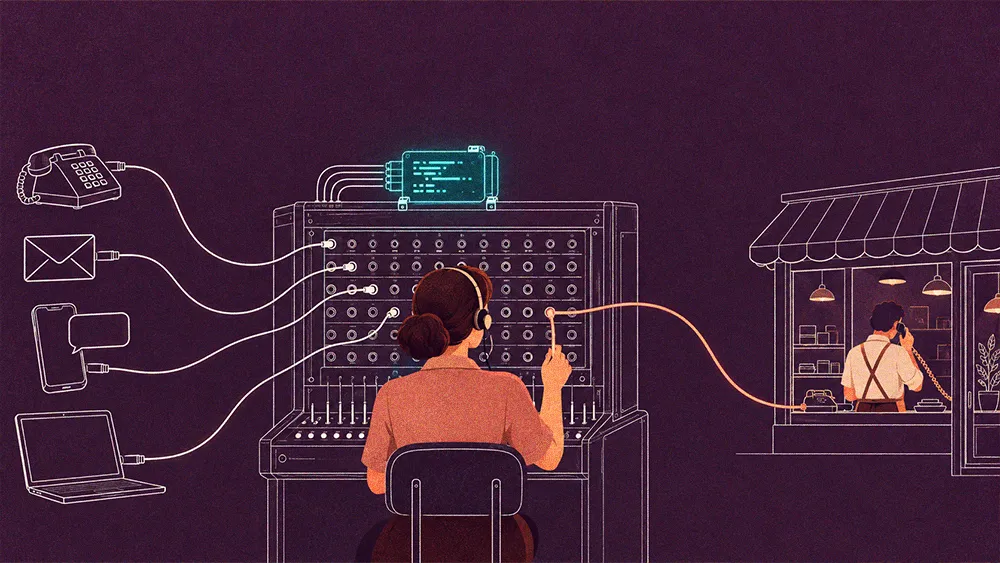
For the moment, Fellers still runs customer service on the phone alone, through a push-button menu. McCahan has identified its replacement: one platform meant to give each customer a single record instead of a series of separate tickets. The record will hold what they ordered and what they asked about. "We're combining phone, email, SMS text, RCS text, live chat, and social media channels all into one platform so that we're then agnostic to channel. But it's all flowing through the same sequences, the same skilled people," says McCahan.
The AI comes next. McCahan plans to put it on the phone first and in digital channels later, and to run it on the agent's side of a call as well as the customer's. Call summaries will go to the sales team or to marketing. Either one can then match a shop buying fleet graphics with a product it hasn't tried, like the film that lowers the temperature inside a vehicle. "We want to eliminate the mundane through AI interaction," McCahan explains. "We want to have AI assist the consultative process, where you want to buy something but you're not sure of the application and the brand you want. My AI could say, 'Let me get you to a trained human expert.'"
McCahan plans to launch each piece in a narrow test first, a discipline he brought from the Army. The first voice test will detect whether a caller speaks English or Spanish and answer in that language. The second will listen for what the caller wants and route it the way the menu does now, sending order calls, status calls, and invoice calls each to their own queue. He plans to read each test for where customers drop out and who asks for a person sooner.
When it comes to routing after those tests, McCahan wants to return the customer to a rep they have dealt with before. "We're going to give you me, if I'm available. If I'm not available, we're going to give you somebody else, but that person's going to mention, 'Oh yeah, I was just talking to John,' because they can read my notes," says McCahan. "We have 100 agents who are servicing the country. We're just being efficient about it, but also creating customer alignment."
Insights beyond a single call
The AI answering the phones will also produce data, and McCahan wants it read for what it says about the business instead of the single call it came from. He expects it to show which items come back most often, what stops a sale, and which complaints repeat. "If we're getting a bunch of complaints about boxes collapsing and damaging the product, which creates a refund and a return, is it a specific lot number or a specific manufacturer? We can say, 'Hey, did you change boxes recently?'" says McCahan. "We need help here, or we need you to use more tape, or we need a better box."
Instead of running the project himself, two employees on McCahan's team are in charge of installing the new system. One has two decades in the business and is wary of AI, and the other uses it constantly. The two of them run the briefings together, so the agents will know the system before any customer sees it. Staff sat in on every vendor demonstration, and McCahan wants employees to view the project as a change in tools instead of a plan to cut jobs.
McCahan judges a company's commitment to customers by where it puts its most senior customer role, and throughout his career, he has seen that role buried under operations, warehousing and sales. At Fellers that role sits at the C-level, and McCahan is in the room when a cost cut comes up that would land on the customer. A year from now, he expects customers to notice the difference. "You can trust us when you talk to us, and our online experience is easy. And if you need help online, you can get to a human quickly. That’s what I want to build this into," McCahan concludes.