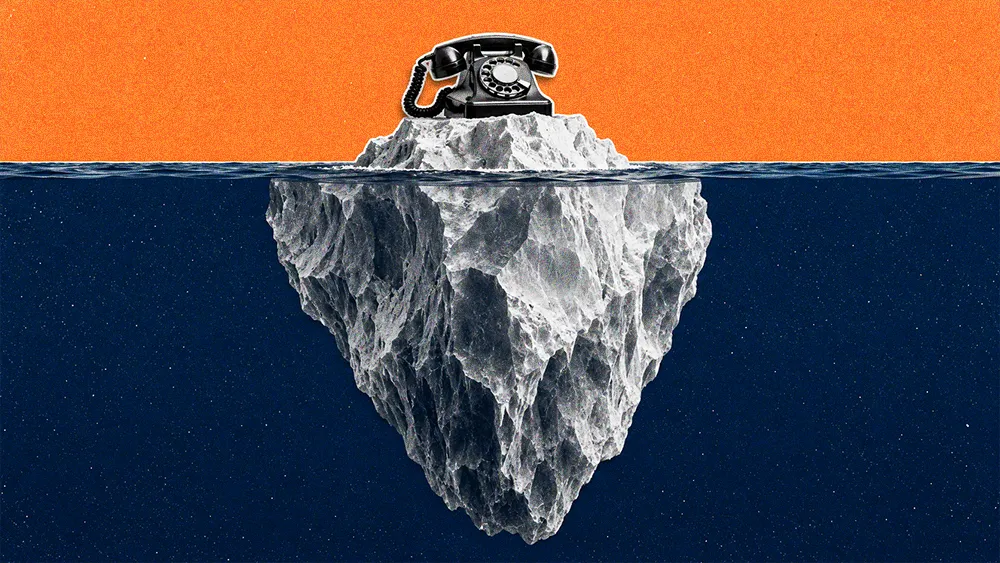



It’s not that people are intentionally lying. They genuinely believe they are doing these things.
 Gavin JohnstonDirector of User Experience Research, Hyatt Hotels Corporation
A resort in the Bahamas kept seeing the same group of guests return. Observant Jewish travelers from Miami and New York arrived in parties of 15 or 20 and stayed for a week, and someone on the property noticed a need going unmet. That observation led to a kosher restaurant. The group was too small to stand out in guest surveys or booking reports, and their needs only became clear to someone watching in person.
Gavin Johnston is Director of User Experience Research at Hyatt Hotels Corporation, where he built the company’s research department. Trained in linguistic anthropology, he spent years on the digital agency side, including as chief anthropologist at Two West, before helping develop the research team at Cerner, now part of Oracle Health. His team studies how guests and hotel colleagues use Hyatt’s products inside its properties.
“We can spend as much time on the interface talking with people as we like. We’re going to get very different things if we are in the hotels, understanding how this interface we’ve designed works beautifully until 300 people are trying to check in because a snowstorm at O’Hare blew it all out,” Johnston says. He describes it as the difference between usable and useful. His team’s job is to find out whether a product holds up when people depend on it most.
Sincere answers still mislead
A usability test can show that a hotel colleague is able to finish a task. It says much less about how that task goes on a sold-out Saturday night with a line at the desk, and that’s the version guests experience. Johnston’s team treats what people say as a starting point. The way a colleague uses a tool during a rush rarely matches how they describe the work in an interview, and an AI system trained on the interview version carries that gap forward.
“People unintentionally lie. You ask people, ‘Do you go to the gym regularly?’ ‘Oh, yeah, sure I do.’ The practical reality is I believe that I’m going to the gym four days a week. It’s probably more like two, if I’m lucky,” Johnston says. “It’s not that people are intentionally lying. They genuinely believe they are doing these things.”
Nobody in that exchange is acting in bad faith, which matters for teams scaling research with AI. When interview questions haven’t been tested in the field, a thousand guest conversations can return a thousand aspirational versions of those guests, and a clean-looking dataset makes them easy to trust.
Booking data has the same blind spot, and so do other standard metrics read in isolation. Johnston’s first trip as an empty nester could look identical on paper to his brother’s annual vacation, even though his brother’s trip is a routine and his own is a couple relearning how to travel without kids.
Internal tools are harder still. People asked about software they use every day tend to either perform competence or vent, so responses cluster at the extremes. When teams feed those extremes into an AI system without asking why people answered that way, the patterns it finds reflect the loudest answers.
Observation turned an outlier into a market
Cinkō Asian Latino Grill opened at Grand Hyatt Baha Mar as the Bahamas’ first kosher restaurant, and one restaurant grew into a practice. The resort added a kosher food truck and Shabbat meal service, then brought on a weddings and events manager focused on kosher and cultural celebrations. Growth like that rarely comes out of an optimization exercise. Optimizing around a resort’s guest mix tends to push resources toward the middle of the distribution, where most of the revenue already sits. The opportunity came from treating a small, repeat group as the leading edge of a market.
“If you looked at the numbers, they’re not by any means the middle of the bell curve. These are exceptions,” Johnston says. “There’s no way, unless you’re in the presence of people and starting to notice these things, where it suddenly clicks to go, ‘Oh my God, this is an audience we can build a practice around.’”
Spotting a group like that depends on who is doing the looking, and Johnston’s team brings very different backgrounds to the same lobby. He describes himself as a 6-foot-7 Midwesterner in his 50s and points to a colleague based in Bogotá, who has also lived in Spain, as someone who reads the same field notes in ways he wouldn’t. “It’s in that conversation that she and I have back and forth where we start to find common ground and say, ‘Okay, this is the really interesting stuff,’” Johnston says. Two researchers debating what a scene means adds a check the data can’t supply on its own, and it’s often the moment an outlier stops looking like noise.
AI tests what researchers have already found
Hyatt has moved quickly on guest-facing AI, including a ChatGPT app for conversational hotel search. Johnston’s research team works under a strict governance model that defines where AI fits in each study, and stakeholders agree on it before work begins.
Before deciding where AI can help, the team maps the different occasions in which a product or behavior appears, because context determines which questions AI can answer reliably. The resulting document can run several pages. Johnston uses light beer as the illustration. “Where are all the occasions that people drink light beer that are different than drinking craft beer? It’s picnics, it’s grandma’s birthday because it’s inoffensive, it’s watching a game. It then allows us to go in and segment and say, this is where we can use it today. This is where we can’t. Here’s where we’re going to find the most value.” The map tells the team which situations AI can study from the answers people give and which ones still need a researcher in the room.
From there, interviews and in-hotel encounters produce a hypothesis, sometimes after just seven or eight conversations. The team then uses an AI agent to interview 80 or 100 more guests or colleagues with questions the researchers wrote, checking whether the pattern holds across the larger group. It’s a similar idea to how contact centers use conversation intelligence tools to find patterns across thousands of calls. Those answers carry the same limits as any survey, which is why the questions come from what the team already saw in person. Generative AI has shown promise for early-stage market research, and Johnston brings it in once the questions are sharp. “It’s a good bridge between the really rich qualitative side and the quantitative side. It’s that thing that brings the two together,” he says.
The next valuable AI pushes back
Johnston sees a bigger opportunity a few steps further out. A traveler planning a fishing trip to Seattle doesn’t start on a hotel website, and he places Hyatt about three steps into that decision. He hopes to see AI that recognizes where the planning begins and helps a company figure out how to reach travelers well before they land on its site.
“At the point at which AI can say, ‘Hold on, that actually starts way back here, so here’s what I think you can do to bridge between there and here,’ that’s when things get really interesting,” Johnston says.
Pointed inward, the same capability could save research teams from their own momentum. “God only knows how many hours people have wasted, myself included, generating ideas only to realize, no, that was not it,” Johnston says. “Somebody should have told me to stop this six months ago.”