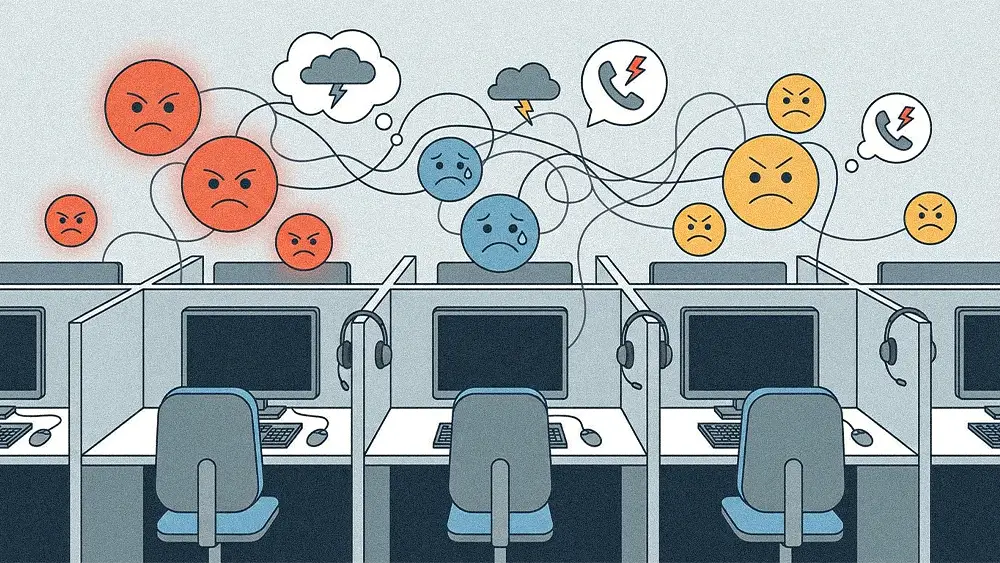

AI Elevates CX From A Cost Center To An Enterprise Intelligence Hub
Veteran CX leader Michael Windler explains why the contact center's future is about gathering intelligence that drives revenue and supports product improvements, rather than merely cutting costs.

Make CX Current News one of your go-to sources on Google


Historically, contact centers have been cost centers. They were just an OpEx line. With AI and automation, you can gather data and insights that turn that cost center into an intelligence center.

Michael Windler
AI is rapidly redefining the contact center, transforming it from a cost center to be optimized to an engine for gathering meaningful customer intelligence. The shift is prompting a change in how leaders measure success, demonstrating value through revenue growth and product improvements rather than siloed metrics like ticket resolution times.
To learn how brands can stand out amid evolving technology and elevated customer expectations, we spoke with Michael Windler, Director of Customer Operations at NerdWallet, a fintech tool designed to help users make informed financial decisions. As a senior customer experience executive with more than 20 years of success transforming B2C operations, Windler describes a fundamental evolution in the contact center’s role.
"Historically, contact centers have been cost centers. They were just an OpEx line. With AI and automation, you can gather data and insights that turn that cost center into an intelligence center," says Windler. Instead of being a line item, he says, that intelligence center proves its own ROI.
The end of no-man's-land: Windler says navigating this foundational pivot begins by tackling fragmented ownership, which is a primary source of customer friction. "Often, customer support is kind of in no-man's-land. As the sales team is focused on driving revenue on the front end, they're not thinking about the back end of the funnel. What support deals with what happens after the fact." This, he says, is a critical misstep.
End-to-end ownership: Organizations can improve shared accountability by defining OKRs like customer churn and LTV that extend across department lines. "To an extent, those should be part of the incentivization of the sales team, too, so that they understand that it's not just about onboarding. There's a responsibility for the ongoing support of that customer, as well."
Zoom out for insights: Getting an accurate picture of customer health, Windler says, requires breaking down siloes in reporting. Legacy metrics like average handle time fall short because they only capture a single moment in the customer experience. "NPS and CSAT have become very important guides towards customer health. But they're just that—guides." He advises leaders to zoom out from singular moments to examine the entire customer journey. "Customer health doesn't come from a single data point anymore. You have to look at them holistically."
The intelligence-center model also prompts a reappraisal of the agent's value. According to Windler, the historical view of support as a low-skill function where agents were often undervalued and underpaid is becoming obsolete. As AI increasingly handles routine tasks, the agent's work becomes more demanding. "There are aspects of a customer interaction, like judgment, insights, and signals, that AI and automation cannot illuminate." This makes arming front-line agents with proper skills a priority. "Upskilling is a really important factor."
A seat at the table: To help agents step into this elevated role, many leaders are finding they need a new playbook for engagement. "Empowerment starts with including your agents in the journey as you implement AI. They are the ones talking to customers every day, so they must be part of the decision-making process," Windler says.
Informed = engaged: Transparency not only fosters trust, he says, but generates agent buy-in. "It's critical to close the feedback loop so they understand the reasoning for the actions you're taking. An agent who feels heard and empowered will be far more receptive to the upskilling that needs to occur."
This perspective highlights a key ingredient in how successful brands will operate moving forward. Windler believes the distinction lies in a company's view of AI. "If your primary motivation for leveraging AI and automation is simply to cut staff by 50 percent, you're going to be left behind." The brands best positioned to succeed, he says, will be those that use the technology to listen to their customers, recognizing that they, too, have become more sophisticated. "We talked about the upskilling of frontline agents, but we must also account for the upskilling of the consumer. Because everyone is using AI today, customer expectations are constantly rising. Brands that evolve to meet these new, higher-level expectations will be the most successful."