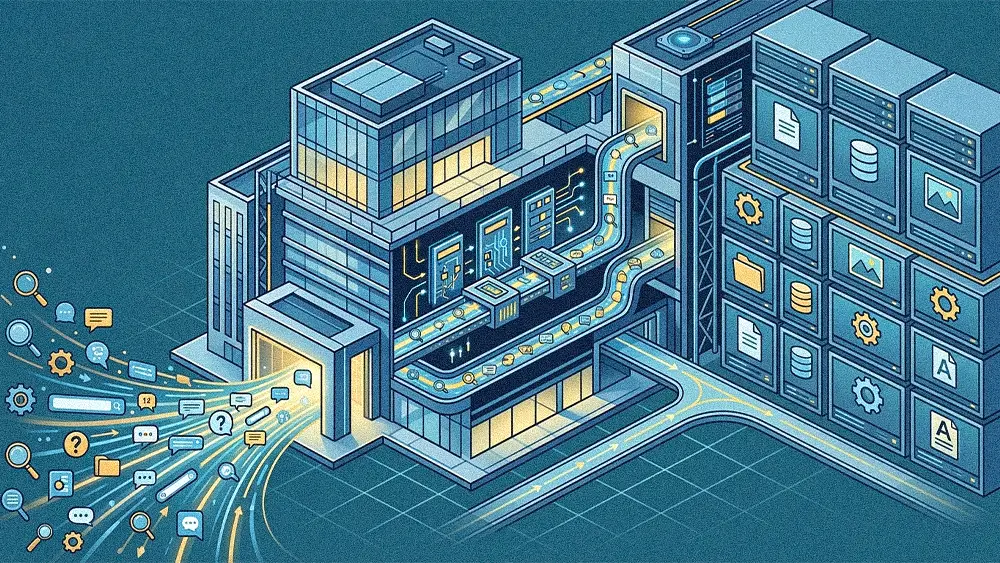

Building Downstream Customer Trust Starts With Early Detection Of Upstream Risk
Strategy and Operations Leader Ryder Erman advocates for using AI to solve supply chain friction and predict demand before it affects the consumer's journey.

Make CX Current News one of your go-to sources on Google


Customer experience is usually a lagging indicator of operational consistency. We're trying to identify breakdowns before the customer feels them instead of reacting after the damage is done.

Ryder Erman
For decades, customer experience in consumer packaged goods has been a game of catch-up. Something went wrong, a customer noticed, and the organization responded. But the factors that shape whether a customer finds the product they want, on the shelf they expect, at the quality they trust, are almost entirely operational. Out-of-stocks, late deliveries, poor demand forecasting, and inconsistent execution at the store and distribution center level all create friction that the customer experiences as a brand failure, even when the brand's customer-facing teams are performing well. The CPG organizations getting ahead of this are flipping the model, using AI to detect and resolve operational breakdowns before they ever become visible to the consumer.
Ryder Erman is seeing this shift play out firsthand. As a senior Strategy and Operations Leader in the CPG space, he manages a sprawling $130M+ multi-site distribution network and co-leads a nine-state regional staffing strategy. From his perspective, which pairs heavy physical logistics with strategic oversight, the variables that determine whether a customer has a positive brand interaction are set long before anyone walks into a store.
"Customer experience is usually a lagging indicator of operational consistency," Erman says. "We're trying to identify breakdowns before the customer feels them instead of reacting after the damage is done. We don't need AI to tell us there's a problem. We need AI to tell us before it becomes visible." He contends that the next frontier of competitive advantage isn't found in the marketing suite, but in the warehouse, where the ability to harmonize data across silos determines whether a promotional promise actually translates into a stocked shelf.
Prediction as the New CX Battleground
Erman's team has built internal signals around order fill rate trends, demand variability driven by seasonality and promotional activity, and service consistency across their distribution network. The goal is to surface actionable intelligence early enough that frontline teams can intervene before a gap reaches the shelf. "What do we need to get ahead of in terms of demand increases for a certain product based on seasonality or event execution or advertising? And with that service variability, are we getting information we can act on before we see the results of it?"
The early outcomes are tangible. Erman reports decreases in customer complaint frequency, improvements in in-stock rates at partner locations, and a reduction in the manual overrides that previously muddled system accuracy and slowed execution. "We've seen a decrease in complaints just from increasing stocks at stores and making sure that when customers enter the market, they're finding the products they're searching for," he says.
Efficiency Without Losing Empathy
The tension Erman returns to repeatedly is the balance between efficiency and empathy. AI can optimize expenses, speed, and consistency, but if it's deployed purely as an efficiency play, it risks eroding the trust that holds customer relationships together. "If we're just optimizing cost, we're not building trust. If we're tackling efficiency through reactive problem solving, we're not being predictive and proactive. If we're just standardizing processes without discretion, we lose the value that a human being brings through their own experience and judgment."
His framework positions AI as a tool that narrows the decision space for frontline teams without eliminating the decision maker. The goal is to make the average human consistently perform as the best possible decision maker by giving them better signals and eliminating low-value, manual work. "AI should remove very high-volume, frequently occurring decisions so that our people can focus on actually improving the customer experience instead of monitoring a ton of data," Erman explains.
Where Implementations Go Wrong
Erman is candid about the failure patterns he sees across the industry. One of the most common pitfalls organizations run into is starting with tools instead of problems. "A lot of organizations get on the wrong foot because they're adopting AI into processes that aren't necessarily going to improve anything. They're investing a lot of money into spots where it's not actually driving results. They start with technology instead of operational constraints."
Frontline trust, he notes, is another critical barrier. If supervisors don't believe in the tools or don't understand how they work, adoption stalls regardless of how sophisticated the technology is. Data quality remains the foundational risk. "Garbage in, garbage out," he says. "An organization that doesn't have enough historical data is feeding AI to make decisions without enough context to drive a well-thought process. You're setting yourself up for failure right out of the gate."
Harmonizing Silos Through Intelligence
In large organizations, Erman sees AI playing a second, less obvious role, breaking down the communication barriers that prevent a unified CX strategy from functioning. "Within a big organization, sometimes those silos don't communicate effectively with each other, so they can't execute the bigger picture. AI is not only going to improve frontline decision making and forecasting, it's also going to harmonize the different silos by streamlining what that communication looks like and how our leaders analyze data to make decisions."
In his view, that harmonization is what connects the operational improvements back to the customer. Better demand signals lead to better inventory. Better inventory leads to better shelf availability. Better availability leads to fewer complaints, stronger trust, and higher retention. None of those outcomes start with the customer. They all start with the operation.
The Line That Defines Winners
Erman's outlook for the next twelve months is clear about where the advantage lies and where the risk concentrates. "The companies that win will use AI to enhance frontline decision making, not replace it," he asserts. "The biggest opportunity is predictive risk identification and eliminating variability. The biggest risk is over-automating without context and losing trust, both from customers and from the frontline teams that are adopting it." He believes the organizations that get this right will treat CX as an operational discipline first, invest in data quality before tool selection, and keep the human in the loop where judgment, context, and empathy still matter. AI narrows the decision space, but the human makes the call.
The views and opinions expressed are those of Ryder Erman and do not represent the official policy or position of any organization.