

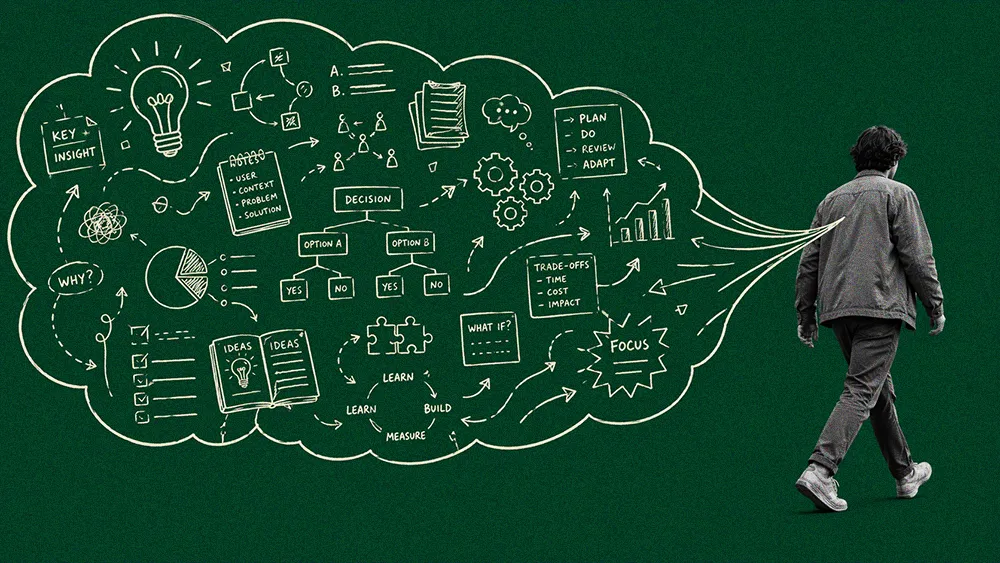
AI can do a lot of things, and it can work on very deep levels. But AI loses context very quickly. Once the conversation’s gone, the context’s gone, it starts making mistakes, and accuracy suffers.
 Ashish KapoorFounding Product Leader @ Tier 1 national bank
AI systems make mistakes when they lose context, and the most valuable context in any enterprise is the kind nobody writes down. The reasoning behind a workaround, the history of why a process exists, the judgment calls that experienced employees make without thinking about it. That tribal knowledge sits in people's heads, not in documentation. When AI lacks access to it, accuracy drops, customer interactions become inconsistent, and frontline teams are left searching through repositories instead of solving problems.
Ashish Kapoor built a $106M+ digital disputes platform from scratch at TD Bank, driving an 86% increase in customer engagement and roughly 25% cost savings through API-driven, AI-enabled automation. Over 14 years, he served as the founding product leader on engagements across TD Bank, Fiserv, the NBA, and Johnson & Johnson, building enterprise platforms in environments where no roadmap existed. His experience across complex, regulated industries gives him a clear view of where AI adoption breaks down.
"AI can do a lot of things, and it can work on very deep levels. But AI loses context very quickly," says Kapoor. "Once the conversation's gone, the context's gone, it starts making mistakes, and accuracy suffers." The core problem, he explains, is that formal requirements capture what a system does but rarely why. That gap between documentation and reasoning is where tribal knowledge lives. "Everybody knows what the code is doing. Somebody wrote down what the code is supposed to do," Kapoor says. "But why they have to do it is not always well documented. That 'why' is the context."
The veteran gap: In most Fortune 500 environments, the employees who carry this knowledge are subject-matter experts whose voices often get drowned out by the speed of agile and AI implementation cycles. "Because of the speed of the process, these veterans' voices somehow get toned down," Kapoor explains. "And there's a plethora of factors why this can happen."
Start with a pilot: Kapoor recommends a structured discovery approach. Pick three candidate teams, narrow to one for a pilot, and ask leadership to identify both SMEs and early adopters. Then go deep. He uses the Japanese "five whys" method to peel back layers of reasoning until the root logic surfaces. "By the time you come to the fourth or fifth 'why,' people know the root of their problem. That is where you figure out what's really driving decisions."
The automated path: For organizations with more AI maturity, the capture process can be partially automated. AI can monitor project-related Slack channels and informal conversations to gather context passively. "AI becomes self-context-aware," Kapoor says. The key is doing pre-discovery work before pulling veterans out of their day jobs.
Once that tribal knowledge is captured and structured, the operational payoff extends across the organization. Kapoor points to three areas where the impact is most immediate.
Developer onboarding: Companies constantly cycle through contractors and new hires who have strong technical skills but no institutional knowledge. "Instead of pointing them to a repository with 500 documents, link them up to an AI-enabled assistant," Kapoor says. "They can just query anytime they want because AI has that context at hand."
Customer-facing teams: Support and sales functions benefit when AI can deliver situation-specific guidance in real time rather than forcing agents to flip through manuals. "AI is taking over that part of interaction with a customer," Kapoor explains. When AI understands not just the product but the reasoning behind processes, customer service teams can handle inquiries with greater accuracy and consistency. "It's pretty efficient," he adds.
Frictionless capture: The biggest implementation risk is burning out the very people whose knowledge you need. "These veterans have their day jobs, and they're always in high demand," Kapoor cautions. "The more frictionless the process can be, the better. Do that pre-discovery work first before you start pulling these people out." He also flags allocation issues: without proper budgeting and time carved out early, discovery phases stall before they produce results.
The urgency is straightforward. Contractors leave. Veterans retire. Employees change roles. Every departure takes undocumented knowledge with it, and once it's gone, no amount of documentation can reconstruct it. Organizations that treat tribal knowledge capture as an operational priority, not an afterthought, build AI systems that actually understand the business they're supposed to serve.
"There has to be a frictionless capturing of this tribal knowledge with your veterans," Kapoor concludes. "Their time is extremely important. So do the pre-discovery work first, and make it as easy as possible."