
Contact Centers Become Insight Centers As AI Surfaces Interaction Data
Jason Mercer-Pottinger, Senior Director of Customer Care for the Americas at Vantive, explains why his team onboards AI agents like new hires and reviews every use case before it reaches a patient.

Make CX Current News one of your go-to sources on Google


When a patient is calling us in the middle of the night and the machine's alarming, it's big human, small AI. We do not pepper it in and just hope and pray that it's going to work.

Jason Mercer-Pottinger
More than 40% of agentic AI projects are forecast to be canceled by the end of 2027, with escalating costs, unclear business value and inadequate risk controls named as the causes. Contact center leaders are running a version of that problem inside their own operations, where executive mandates to deploy AI have arrived well ahead of the cases for doing so. Regulated industries face the sharpest version of it, since a badly-handled automated interaction there costs a company more than a sale. Customer care for patients running dialysis at home is the strictest case, and a tool has to prove considerably more before it reaches a patient conversation.
Jason Mercer-Pottinger is Senior Director of Customer Care for the Americas at Vantive, a vital organ therapy company supporting dialysis patients at home and in clinics across more than 80 countries. He leads patient-facing support operations for the region, working from a background in large-scale contact center leadership, and has directed the deployment of analytics and automation tools inside the care function. Much of his current work involves evaluating AI use cases alongside cross-functional stakeholders to determine where they can safely and effectively support patients, customers, and employees.
"When a patient is calling us in the middle of the night and the machine's alarming, it's big human, small AI. We do not pepper it in and just hope and pray that it's going to work," says Mercer-Pottinger. Vantive uses the technology most heavily away from the live call, in back-end analysis of what happened during interactions. Mercer-Pottinger separates that work from the headcount case that dominates most contact center AI discussions. He applies the same distinction at every stage, from approval through release and measurement. Conversational AI and agent-assist capabilities are evaluated and deployed selectively within service operations where they can demonstrably improve the customer and employee experience.
Mapping before automating
Before Vantive evaluates any product, it settles whether the problem needs AI at all. Answering that question early rules out a large share of the tools on offer, and it stops a vendor from framing the problem it is being paid to solve. Vantive also already runs digital tooling across its therapy programs, so anything new has to outperform what is in place. "We start with a very ethical view on where AI is going to add the most value to our patients," notes Mercer-Pottinger. "We are supporting patients at home on dialysis, so before we bring in any technology, we do a lot of journey mapping around our patient experience."
Once a use case clears review, the technology enters the operation under conditions most organizations never impose on software. Elsewhere, a tool often reaches live traffic on a vendor's assurance and nothing else, with no supervised period and no owner accountable for how it performs once the launch team moves on. Vantive treats that missing ownership as the larger risk, well ahead of anything the model itself might get wrong. "We apply the same rigor around onboarding, testing, monitoring, and performance validation that we would apply to any critical operational capability," Mercer-Pottinger explains. "They get the same onboarding, they get the same learning. We make sure that we're analyzing them before we allow them to go out into our infrastructure on their own."
Many early deployments have occurred in the United States while the organization continues to evaluate varying regulatory, privacy, and operational requirements across global markets. His team has therefore been able to deploy ahead of Vantive's other regions, though the approval process is the same in every market. Getting a deployment past operations only to have compliance stop it later costs more than the tool would ever have saved, so even proposals that look safe go through the same full review as the rest. "It isn't just Jason coming in and going, 'Hey, I'm going to introduce AI. We have an AI board,'" adds Mercer-Pottinger. "We have to go use case by use case to make sure everybody understands the complexity, any regulatory issues."
From contact centers to insight centers
The deployments that clear review have returned the most from work the patient never sees. Sentiment analysis runs across completed interactions, surfacing where technical support or customer service left someone without a resolution and where the person handling the call lacked what they needed to close it. "This has not been to reduce calls, to take out call volume, to reduce heads or anything like that," says Mercer-Pottinger. "It's been how we can add more value back to other parts of our organization through improving that frontline experience for our reps as well as for our patients and our customers."
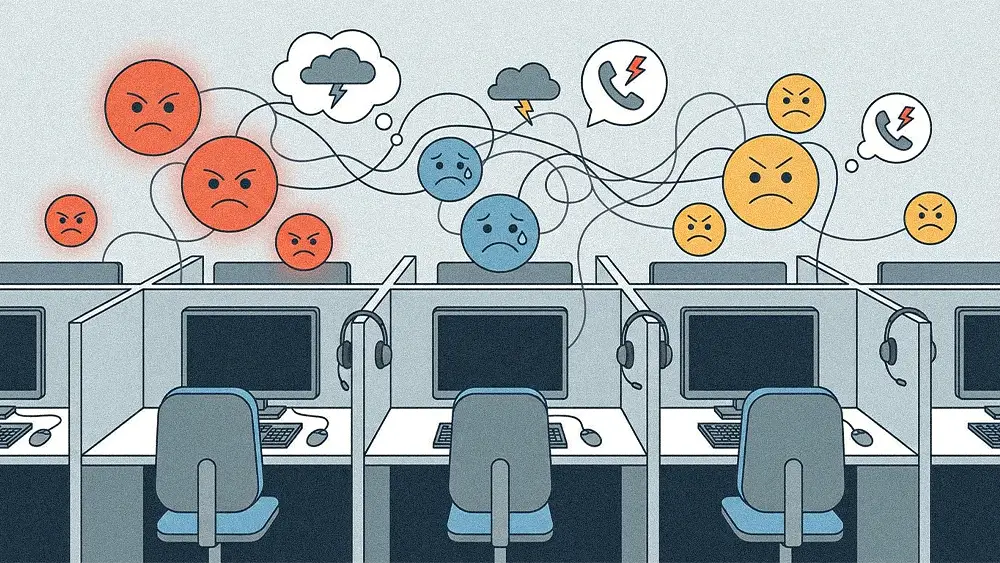
The evidence already exists inside most contact centers. Transcripts, sentiment scores and resolution records from every customer conversation amount to a standing account of where a company frustrates people and why. What most organizations lack is the reporting line that would carry it to the people who could act on it. "One thing that I'm big on is how we stop calling ourselves contact centers and start referring to ourselves as insight centers through the use of all this data that we now have available," Mercer-Pottinger notes.
Mercer-Pottinger applies the same objection to how contact centers measure themselves. The standard operating metrics were designed to describe how a queue behaved, and he says none of them capture anything a customer would recognize as their own experience. A statistic about how quickly most calls get answered means nothing to the person who waited longer than most. "We need to stop managing our contact centers like it's 1999," Mercer-Pottinger explains. "What we should be doing is building from the outside looking in, and a lot of that is first contact resolution and customer effort score."
Push back before you purchase
An AI system reads across a company without any knowledge of the boundaries that company built for itself. It follows a process as written and queries whatever data it is pointed at, which produces an unusually accurate picture of how a business runs day to day. Mercer-Pottinger's experience is that deployments stall on organizational structure well before they stall on model performance. "AI is going to uncover some of the inadequacies that we have in our organizations," adds Mercer-Pottinger. "We've built silos because that's just how they've evolved, and the humans become the band aids. The AI does not understand our band aids because they're not human."
A pilot that works inside one department frequently cannot be extended past that department's boundary, and the reason has nothing to do with the technology performing badly. Programs then go nowhere while everyone looks for a technical fix that doesn't exist. Sponsors rarely scope for the structural work at the outset, since it costs considerably more than a software purchase and falls to people outside the project team. "Organizations who want to implement AI at scale are going to have to de-structure to restructure to enable the AI to be successful," Mercer-Pottinger says.
Deciding what to buy and what to refuse falls to contact center leaders themselves, and Mercer-Pottinger uses the term "skill stacking" for what the role now requires. The addition he has in mind is enough AI fluency to evaluate a vendor claim without relying on the vendor, which does not require becoming an engineer. A leader who cannot assess what a tool will and won't do gets overruled by peers elsewhere in the business, and the operation then lives with a decision its own leadership didn't make. "We would do the same with any CRM or ACD," Mercer-Pottinger concludes. "If there's no value, guess what, we're not going to invest in it."