
That chatbot is only as good as the data. If you're going to start anywhere, you need to make sure your documentation is accurate.
 Rosetta LueChief AI Transformation Officer @ GovCXP Digital Partners
Customer experience leaders have an external benchmark for measuring whether their operations can support AI agents. ISO 18295, the international standard for customer contact centers, sets requirements for how service processes get documented and how customer interactions get handled. The criteria extend to any team fielding customer requests, and running an operation against them before deployment shows leaders which gaps will limit what an AI agent can do once it goes live.
Costs have dropped far enough that a small service organization can deploy AI agents without a large upfront investment. Readiness now comes down to documentation, since an AI agent can only work from the procedures a team has written down.
Rosetta Lue is Chief AI Transformation Officer at GovCXP Digital Partners, a consultancy that advises government agencies on contact center modernization and AI adoption. She served in the Senior Executive Service at the U.S. Department of Veterans Affairs, where she worked on modernizing the agency's enterprise contact center operations, and she directed Philly311 for the City of Philadelphia, where she helped build the constituent CRM platform behind it. Her assessments now run government contact centers against a stack of ISO standards covering operations, knowledge management, and AI governance. The technology in those centers matches what a private sector support organization runs, which is why the same gaps surface in both.
"That chatbot is only as good as the data. If you're going to start anywhere, you need to make sure your documentation is accurate," Lue says. The ISO standards give her a fixed list of criteria to check an operation against, covering how procedures get recorded and how consistently a team follows them.
Grading the operation
Operational readiness is one of eight readiness areas Lue evaluates, alongside executive sponsorship, workforce training, data quality, and measurement. ISO 18295 supplies the criteria for that one. The criteria are set in advance, and the review runs from outside the organization. What comes back is a set of gaps specific enough to assign owners and deadlines. Certification is available to centers that want it, though most of the value lands during the review itself. "There are four or five that I have in my stack that I can come in and assess where you are. We fill those gaps so that you're ready when the next step is technology," she adds.
Findings framed this way also travel. A gap identified against an international standard carries weight in a budget conversation that an internal finding does not, and boards recognize the reference point without needing the operation explained to them. "If we're all on the same standards, like manufacturing, we're all building the bolt the same way, and we know what that bolt has to include," Lue notes.
Knowledge base first
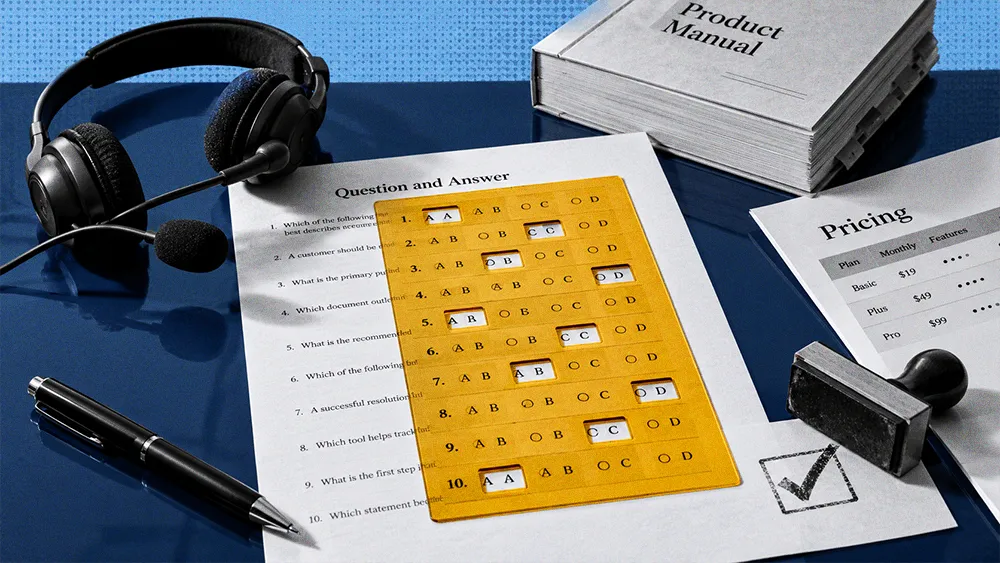
The knowledge base is the internal library a service team works from, holding the documented answers and step-by-step procedures a team follows to resolve a request. An AI agent draws on that same source. Accuracy and consistency across those entries determine what a customer receives on the other end. That puts the knowledge base at the top of those readiness areas.
It is also where Lue tells teams to start when there is no budget for new technology, since the work runs on staff time and existing tools. A cleanup returns a result fast enough to build internal confidence for the next project. "If we're going to do something, we want to make sure that knowledge base is providing accurate information and consistent information," Lue says.
The knowledge base also outlasts the people who fill it. Procedures carried in the heads of long-tenured employees leave when those employees do, and their replacements inherit a version no one has written down. Writing those steps in turns individual expertise into something the operation can audit and hand to an AI agent. "You have standardized your operations. Rather than the tribal knowledge that walks out the door, it's in the knowledge base," she adds.
Training builds adoption
Those procedures stay undocumented for reasons that have nothing to do with process design. Staff who have built expertise over years are rarely told what happens to their role once that expertise is written down, and the silence is what creates the hesitation. Lue sees adoption rates move in proportion to how much time leadership spends answering that question directly. Training on the basics helps, including what prompting means and what the technology does with the information it receives. Once teams can see how the tool works, recording what they know stops carrying the same weight.
The reassurance that lands is specific about what the work becomes. Automating routine steps moves people onto the interactions that need judgment, and those are the ones customers remember. "You want to automate as many processes as you can, but keep people as part of that human in the loop. For complexities, we're going to need humans. You're going to need empathetic people," she notes. Documented procedures and a prepared workforce make a deployment possible. How much of the operation that deployment covers determines what the organization gets back from it.
From weeks to minutes
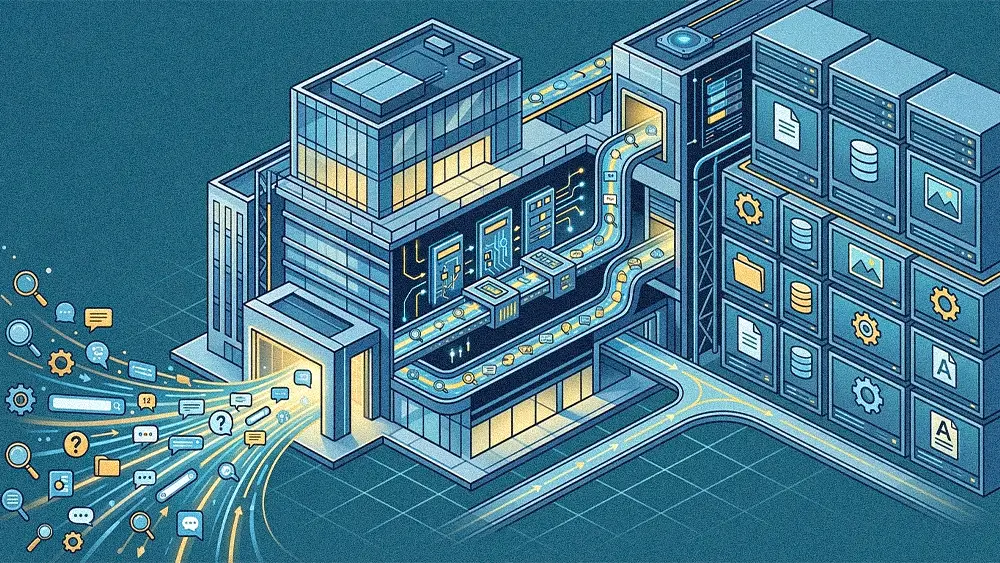
Lue maps a process from the first request to the final step before scoping a pilot. The front half of that path is what a customer interacts with, and the back half is the internal work that fulfills the request. Pilots tend to cover only the first half, since that is where improvement shows up fastest.
Automating the full path changes what a team can measure. Resolution at the first point of contact is one measure, and instrumenting every step adds a second that covers what happened after the handoff. Measurement is the eighth of those readiness areas, and a KPI defined before deployment gives leadership something to point at when the next budget conversation starts. The reductions available at that stage tend to be large, because requests that once moved through manual handoffs across several departments compress once no person has to route each step. "I'm seeing a difference where instead of things taking six weeks, it now takes six minutes because you've automated that whole process," Lue says.
Expectations set elsewhere
Customers now arrive at a permit counter or a support line carrying whatever standard the last service they used has set. That standard comes from companies competing hard for attention, which puts every service organization into the comparison whether it has competitors or not. Listening is the first of Lue's eight readiness areas for that reason, and public agencies now run the same user research consumer companies have used for years. The findings also change the relationship, since people who see their input reflected in a service extend more trust to the organization that acted on it. "Amazon and Apple would go out and talk to the folks to find out how they're using the products and what they need in the products, so they can be very targeted with that spend. Whereas in government, we just used to make assumptions," she observes.
Research reaches a customer only through the operation behind it. An insight becomes a better service once the knowledge base and the process behind it can support the change, which is the work Lue puts ahead of any deployment date. "How do we become more efficient at it? How do we do it faster, better, smarter, cheaper than we did it before? That is where the importance of that foundation needs to be driven home," Lue says.