When a Lab Result Can Change a Life, Healthcare CX Teams Measure Every Step Leading Up to It
Gaurav Jain, COO of Redcliffe Labs, shares how automated booking speeds up home blood tests while patient ratings and a ready helpline keep people confident in their results.
Make CX Current News one of your go-to sources on Google


Everything we do is with the mindset that there’s a customer at the center. In healthcare, that matters even more, because there’s someone’s life at the center.

Gaurav Jain
When a patient waits on a lab result, the stakes are personal. A single number on a report can shape a treatment plan or start a hard conversation at home. As diagnostics companies automate booking, scheduling, and reporting to meet rising demand for at-home testing, getting a test becomes faster and easier. Those companies also have to make sure the speed never costs patients their trust in the result.
Gaurav Jain is the Chief Operating Officer at Redcliffe Labs, a diagnostics company that offers lab testing and at-home blood collection across India, with a focus on affordable access in smaller cities. He oversees home collections, logistics, lab operations, and customer experience and support. He joined Redcliffe in 2021 to lead growth and later ran the company’s online business, including its contact center sales team and home collection operations in more than 130 cities. Before Redcliffe, he spent more than four years in key account management at eye care company Alcon, co-founded a pharmacy startup, and helped build a business unit serving doctors and clinics at at-home testing company Healthians. In his view, every patient deserves high-touch care.
"Everything we do is with the mindset that there’s a customer at the center. In healthcare, that matters even more, because there’s someone’s life at the center," says Jain. Patients awaiting test results are often anxious, and a late collection or a confusing report can feel like the company has let them down. They need clear communication and someone to turn to with questions. Redcliffe uses software for scheduling and routing, and keeps staff available for the moments when a patient needs help.
Two paths to a test
Redcliffe gives patients two ways to book a test. The first is a self-serve app and website that sorts tests and packages by health condition, so someone managing diabetes or a heart condition can tap a category and see the options that apply to them. The app uses the phone’s location to show open home-collection slots over the next few days, then displays a full cost breakdown and lets the patient pay upfront or at the time of collection. It also suggests tests based on patterns among people of the same age or in the same area. If people in a region often show low vitamin D levels, for example, the app flags that test and lets the patient add it with one click. "You can book a home collection with us in as little as 45 minutes. It’s almost like booking an Uber," adds Jain.
Patients who want more help can call a dedicated helpline instead. A staff member answers questions, explains which tests fit a condition, and adjusts a package to suit the patient. A confident returning customer can book in a minute, and a worried first-timer can talk it through with someone before committing.
Redcliffe keeps building automation, but it treats the phone line as a permanent part of the service. "Healthcare is very personal to the customer, so we want the human element to always be there as an option if the customer wants it. While we’re building automations, we’re also very mindful to keep the human element at the centerpiece," notes Jain.
Mapping each home visit
Home blood collection is a standard service in India, offered by most of the country’s major diagnostics companies. After a patient books a time slot, a phlebotomist, the trained staff member who draws blood, comes to their home to collect the sample. The phlebotomist then hands the sample to a courier, who carries it to a lab for testing.
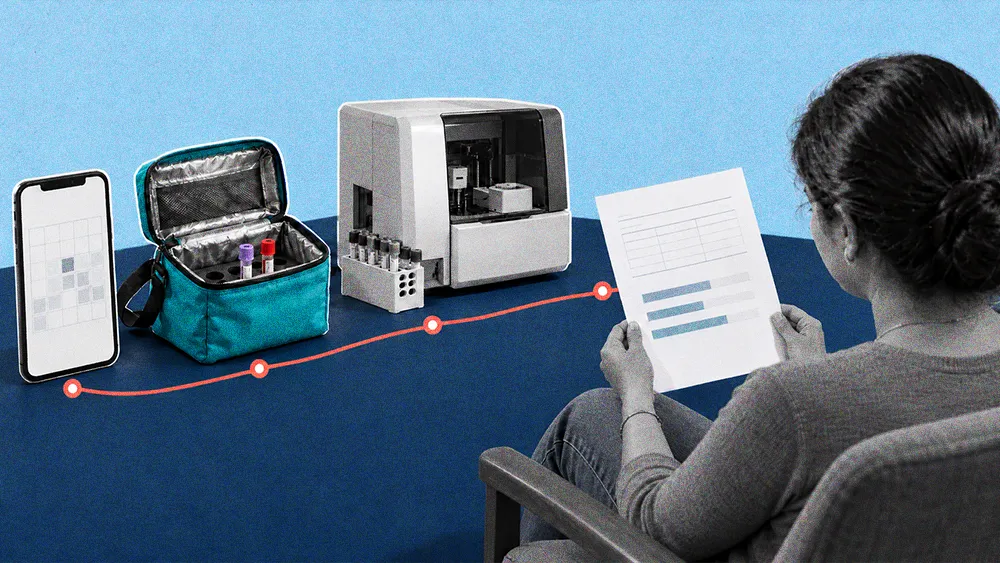
Running that service across many cities takes careful coordination. Patients book hour-long windows throughout the day, and blood samples need to reach the lab quickly and at the right temperature to produce accurate results. Redcliffe assigns each phlebotomist to a zone drawn on a digital map. When a booking comes in, the system matches the patient’s address to the right zone and phlebotomist, then plans that person’s full day of visits in order, including where to hand off samples for transport.
With the full schedule planned in advance, phlebotomists can move from one home to the next without stopping to check for their next assignment, which helps them arrive on time. "Our phlebotomists don’t need to keep going back to the system to check where to go next. They can see their entire route for the day," says Jain.
A patient’s experience depends on many steps going right, from the booking to the visit to the final report, and a slip at any one of them can leave a lasting bad impression. Banks and insurers face a similar challenge. They run much of the customer journey through automated systems, and a delayed loan decision or a mishandled claim can upend someone’s life. Businesses in any of these fields need a clear view of where things are breaking down.
Trust at every stage
Redcliffe tracks Net Promoter Score, a common measure of how likely customers are to recommend a company. It also breaks the patient journey into five stages, starting with booking and test discovery and moving through sample collection, reporting, and after-sales service. At each stage, the company asks a portion of patients to rate that specific step. “Whenever a customer is interacting with a particular stage of our process, we do a dip check with, let’s say, 20% of those customers to get their rating on that part of the service,” adds Jain.
Redcliffe combines those ratings with app store reviews, Google ratings, and social media comments into a single customer experience score, then breaks that score down by city, lab, and region. A strong national average can hide one city where visits run behind schedule. Scoring each stage in each location brings those problems into view so leaders know where to focus.
The same care extends to the test results themselves. Occasionally a sample doesn’t meet the lab’s quality standards. In those cases, Redcliffe holds the report until it can stand behind the result. “We might go for a resampling, refrain from reporting, or even go for a refund. That’s not a problem. But we would never release a report we’re not confident in,” says Jain.
A second blood draw is an inconvenience, but most patients would rather wait a little longer for a result they can rely on. Explaining the reason for the delay helps patients accept it.
Repeat customers also receive a smart report that compares new results with past ones and marks which measures have improved, stayed the same, or gotten worse. A patient whose cholesterol was out of range on the last test can see right away whether it has come back down.
Beyond the booking
Patients in India now expect booking a lab test to feel as easy as ordering anything else on their phones. Once that part is simple, they return to the labs that deliver dependable results and explain them clearly.
Redcliffe plans to push automation further into both reporting and operations. The company is working on reports that read several test values together, since numbers that tell one story on their own can tell a different one as a group. It is also exploring temperature sensors in phlebotomists’ bags that would alert staff when a sample needs cooling, and it is testing a fully automated lab where machines scan each tube’s barcode, send it to the right equipment, and run the test before a doctor reviews the results. Each new tool still has to serve the person waiting on the result. "Customer experience is at the center of our operations and the center of our business," says Jain.