
Airline Customer Experience in 2026: What Delta, United, Alaska and Southwest Are Doing Differently
How four U.S. airlines and one of the country's busiest airports are rethinking airline customer experience, from the contact center to the gate
Make CX Current News one of your go-to sources on Google


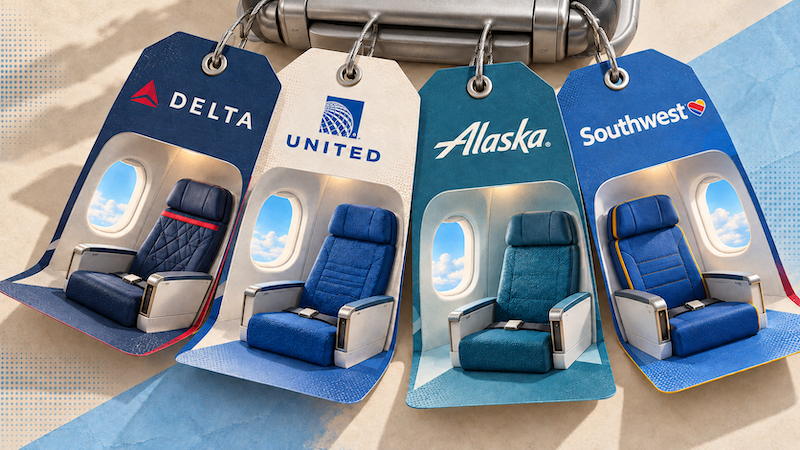
U.S. airlines are raising fares and bag fees, and passengers are still rating them higher than they did a year ago. Delta ranked first in the 2026 American Customer Satisfaction Index, and Southwest led J.D. Power's economy rankings for a fifth straight year. Behind the scores, customer experience leaders at Delta, United, Alaska, Southwest and Orlando International Airport are working on many of the same problems. Most of that work starts with an operation that holds up on bad days. From there, United and Alaska are using what customers say on calls to decide what to fix, and Delta and United are giving travelers ways to sort out a disruption themselves while keeping an agent within reach.
Airline customer experience is having a better year than the headlines about fares might suggest. J.D. Power's 2026 North America Airline Satisfaction Study, released in May, found satisfaction up 8 points on its 1,000-point scale, with first and business class up 17 points, premium economy up 14 and economy up 6. The ACSI Travel Study put the industry at 76 out of 100, one point below its all-time high.
Michael Taylor, who leads J.D. Power's travel practice, said airlines had returned "to basics of passenger communication, friendly service and providing slightly better value for money compared to past years." He also cautioned that higher fares and bag fees, pushed up partly by fuel costs, could make those gains hard to sustain.
Washington has left more of the service equation to the airlines themselves. In November 2025 the Department of Transportation withdrew a proposal that would have required cash compensation for long delays, saying carriers should "compete on the services and compensation that they provide to passengers." The 2024 automatic refund rule is still in force, apart from a temporary carve-out for flights that are only renumbered. Beyond a refund, what a traveler gets on a bad day depends mostly on the airline they booked.
Several of the people making those decisions at Delta, United, Alaska, Southwest and Orlando International Airport were named to CX Current's Top 50 Leaders Transforming CX this year.
Five approaches to airline customer experience
Delta builds on the operation
Delta finished first in the ACSI study with a score of 79, and J.D. Power ranked it first in premium economy for the fourth year running. Ranjan Goswami, Delta's chief marketing and product officer, oversees marketing, product, partnerships and experience design together and draws little distinction between them. "The brand is the product and the product is the brand," he says.
Goswami starts with the operation. Once flights run reliably, the next question is how employees respond when a customer needs them, and Delta tracks the answer through an always-on listening program that covers 24 points in the customer journey.
The airline's most visible new tool is Delta Concierge, an AI assistant inside the Fly Delta app. It entered beta in October 2025 and opened to every SkyMiles member in August 2026. Concierge uses a traveler's trip and account details to handle cancellations, rebookings, refund and eCredit requests and bag tracking in ordinary language, and it passes the conversation to a human agent when it reaches its limits. On the airline's July earnings call, chief operating officer Dan Janki said Delta's disruption tools had driven "more than a 25-point improvement in NPS during periods of irregular operation."
United turns calls into fixes
At United, Rachel Walker runs service transformation for customer support and advocacy, and she regards the contact center as the airline's best window into what customers need. "The customer support center is extremely valuable because that's where we hear the voice of the customer," she says. For a long time that knowledge was hard to put to use. "Before Cresta, most of the information that was close to real time was anecdotal. It really wasn't quantifiable."
Metrigy analyst Robin Gareiss described what changed once United began using Cresta's real-time conversation analytics. The airline's fare-change flow asked customers to pay for an upgrade before confirming that their change was possible, and confused customers picked up the phone. United moved the availability check to the start of the flow, and live interactions for that contact type dropped 50%, saving millions of dollars a year. Customers had also been calling about upgrade waitlists, which they could see only 72 hours before departure, so United began showing the list 30 days out.
Some of what the conversations revealed ran against the airline's own expectations. During one disruption, United assumed safety would dominate customer concerns, and the analytics showed that people were far more worried about rebooking. "When we moved to Cresta, we were able to stop making assumptions, use real data to understand our customer needs, and then make decisions based off of that real data," said Brandy Maxwell, senior manager of customer insights and policy execution.
Asif Majeed, who manages contact center performance and analytics, says the calls that remain are getting harder. "As basic transactions are being automated for our customers, our agents are receiving more complex inquiries and requests from our customers," he said. Since deploying Cresta, United has improved handle time by 15%, which in turn improved customer response time by 50%.
Walker also wants travelers to stop repeating themselves. "I want my customers to stop starting over," she says. CEO Scott Kirby wants an AI system that tells customers why a flight is delayed "in clear, plain English" without waiting for someone to write the update. In September, United added a feature to its app, which more than 85% of customers use on the day they fly, that lets disrupted travelers join standby for up to three earlier flights.
Alaska listens through a merger
Alaska has spent the past year folding Hawaiian Airlines into its operation. The two carriers received a single operating certificate in October 2025 and moved onto one passenger service system in April 2026. "We're doing something that no other U.S. airline has done before: Operating multiple brands on a single platform," CEO Ben Minicucci said.
A change that size produces a steady stream of questions from guests, and Alaska wanted to hear them as they arrived. "I think the most exciting thing is being able to see in real time why guests are contacting us," Todd Traynor-Corey, vice president of guest products and experience, said of the airline's work with Cresta. "Prior to Cresta, it would've taken us weeks to even identify that there was an issue, and then weeks after that to really pull the insights and the data to kind of articulate what the problem was." His team now often finds and resolves an issue on the day it appears.
Andrea Halverson, who leads contact center experience and innovation, came to Alaska after nearly a decade working on contact elimination at Amazon, and she still measures success partly by the calls that never happen. "The best guest experience is one where they don't have to contact us in the first place," she says. When the airline changed its baggage fees, she set up a dashboard that showed almost immediately how guests were reacting in their conversations. Lori Bradshaw, managing director of guest care, has brought on many new agents, and she says the same tools help them get up to speed faster and give more accurate answers.
Southwest works to win back trust
Few major U.S. airlines have changed their customer model as much as Southwest has over the past two years. It started charging for checked bags in May 2025, and in January 2026 it ended 55 years of open seating and moved to assigned seats. "This has nothing to do with copying anybody, [it] has to do with offering our customers what they want," CEO Bob Jordan said.
Those changes arrived while the airline was still recovering from its 2022 holiday meltdown, when it canceled 16,900 flights and stranded more than 2 million passengers. The Department of Transportation fined Southwest $140 million. After the airline spent $112.4 million upgrading its network operations control, DOT waived the final $11 million in December 2025, pointing to better on-time performance.
Tony Roach, Southwest's chief customer and brand officer, made rebuilding trust his first priority after the meltdown and has pursued it through open communication and visible fixes to the operational problems behind it. When a trip goes wrong, he wants customers to get context, options and clear signs that the airline cares. "While technology, products, and networks continue to evolve, the way we make Customers feel remains one of our greatest differentiators," he says.
The scorecards so far point in two directions. J.D. Power ranked Southwest first among economy passengers for the fifth straight year, which Roach called "a powerful demonstration of the experience our people provide to our Customers." In the ACSI study, however, Southwest slipped 4% to 77, and ACSI tied part of the decline to the new seating policies.
Orlando designs for the stressed traveler
Airports shape the trip, too. Orlando International handled nearly 58 million passengers in 2025. Tawana Allen became chief customer experience officer at the Greater Orlando Aviation Authority that November, and much of her focus is on travelers who arrive stressed, tired or overwhelmed. MCO opened Annie's Space, a sensory room, in 2025 after an audit found gaps in accessibility, and it has since expanded its Family Zones to all three terminals.
In May 2026, Airports Council International awarded MCO Level 2 Customer Experience Accreditation. Only 16 U.S. airports hold that level, and MCO is the only one in Florida. Allen's office is now building a passenger management platform that collects real-time feedback, analyzes sentiment and pairs round-the-clock AI assistance with live support. "By putting people at the center of everything we do, MCO is continuing to innovate and evolve, defining a new era of airport excellence," she says.
What other CX teams can borrow from the airlines
Delta, United, Alaska and Southwest compete hard with one another, and their strategies differ. Their stories still overlap in ways that apply well beyond aviation.
Each of them treats the operation as part of the customer experience. Goswami describes Delta's service as resting on reliable flights, and Southwest's recovery since 2022 has run through its operations control center at least as much as through its customer messaging.
United and Alaska have also turned the contact center into a source of direction for the rest of the business. United's fare-change redesign and its earlier upgrade waitlists both began with what customers said on calls, and Alaska can now spot an issue the same day where it once took weeks. At United, the largest return came from fixing the flow upstream, which meant those calls stopped altogether.
For disruptions, the airlines are expanding self-service while keeping people in the loop. Delta Concierge hands off to an agent when it can't finish the job, and United's standby feature lets travelers rearrange their own trips. Walker's own testing found that even travelers who are comfortable with digital tools can want someone to "hold their hand" when a trip falls apart.
Kirby's plain-English delay messages, Roach's emphasis on context and options, and Halverson's dashboard on the baggage fee change all come from the same instinct, which is to tell customers what is happening as early and as clearly as possible.
Many of the leaders on CX Current's Top 50 list are doing similar work in banking, insurance, healthcare and retail. Airlines face the test more often and in public, where a storm system or an IT outage can turn an ordinary Tuesday into thousands of urgent conversations.
FAQ
Which U.S. airline has the best customer satisfaction in 2026?
It depends on the study. Delta ranked first in the 2026 ACSI Travel Study with a score of 79, ahead of American and JetBlue at 78 and Southwest at 77. In J.D. Power's 2026 North America Airline Satisfaction Study, JetBlue led first and business class, Delta led premium economy, and Southwest led economy and basic economy for the fifth straight year.
How are airlines using AI in customer service?
Travelers see it most in AI assistants like Delta Concierge, which can rebook, cancel, process refund requests and track bags without an agent. Behind the scenes, United and Alaska use Cresta's conversation analytics to see in real time why customers are calling, and agent assist tools help contact center staff answer faster and more consistently. United is also developing AI that explains flight delays to customers automatically.
Are U.S. airlines required to compensate passengers for delays?
No. The Department of Transportation withdrew its proposed delay compensation rule in November 2025. The 2024 automatic refund rule still requires airlines to refund passengers when a flight is canceled or significantly changed and they choose not to travel, though DOT has paused enforcement through July 2027 for flights that are only renumbered.
What is Delta Concierge?
Delta Concierge is an AI assistant in the Fly Delta app. It uses a traveler's trip and account information to help with disruptions, cancellations, rebooking, refunds and bag tracking in natural language, and it hands customers to a human agent when needed. It became available to all SkyMiles members in August 2026.
How does United use its contact center data?
United uses Cresta's real-time conversation analytics to see why customers are calling, spot friction in its policies and digital tools, and confirm whether changes work. One fix to its fare-change flow cut live interactions for that contact type by 50%, according to Metrigy.