
What Is Agentic AI in the Contact Center? How It Differs From Conversational and Generative AI
How three generations of contact center AI differ, and how to tell which one you're buying
Make CX Current News one of your go-to sources on Google


Conversational AI interprets what a customer is asking and responds through flows that were designed in advance. Generative AI writes new language, such as replies, call summaries and suggested answers. Agentic AI works toward a goal, deciding which steps to take and using business systems to carry them out. Most contact centers now use all three, often within a single product, and that overlap explains much of the confusion around the terms.
Why the definitions are muddled
Metrigy found that about 52% of CX leaders knew the term "agentic AI" in early 2025, and its preliminary data a few months later put the figure in the low 70s. Metrigy CEO Robin Gareiss said in the same discussion that people give widely varying answers when asked how conversational, generative and agentic AI differ.
Gartner uses the term "agent washing" for relabeling existing chatbots, AI assistants and robotic process automation tools as agentic when they lack meaningful agentic capability, and it estimates that only about 130 of the thousands of vendors making agentic claims actually deliver them. The same research forecasts that more than 40% of agentic AI projects will be canceled by the end of 2027 because of rising costs, unclear value or weak risk controls.
For buyers, a product sold as agentic may turn out to be a scripted bot with a newer interface, and a team that expects autonomy from it will plan the wrong rollout.
Conversational AI: interpreting the request
Conversational AI is the oldest of the three in most contact centers. The category includes the intent-based chatbots and speech-enabled IVR systems that companies deployed widely over the past decade. These systems use natural language understanding to classify a request, such as a balance check, a password reset or an order status question, and then follow a flow someone built in advance.
That design makes them dependable for high-volume, predictable requests and easy to audit, since every path was built by hand. Cresta's head of product, Joshua Levin, has described how flow-based bots followed strict, predefined paths, so the same input always produced the same output. They struggle with anything the designers didn't anticipate. A request that doesn't match a known intent ends in a generic reply or a transfer, and any judgment the bot exercises has to be scripted explicitly. The Consumer Financial Protection Bureau's 2023 review of bank chatbots found that rule-based systems built on decision trees or keyword lists handled basic questions reasonably well and became less effective as problems grew more complex.
Generative AI: writing the response
Generative AI, built on large language models, changed what contact center software could produce. It writes new text instead of choosing from prewritten responses, so it can draft a reply to a customer, summarize a call, suggest an answer to a human agent or produce a first version of a knowledge article.
Its first large-scale use in contact centers was helping people do their jobs. A study by economists at Stanford and MIT, published by the National Bureau of Economic Research, followed 5,179 customer support agents and found that a generative AI assistant raised issues resolved per hour by 14% on average and by 34% for newer and lower-skilled agents. The researchers also reported better customer sentiment and higher employee retention. Cresta, which publishes CX Current, has said the deployment studied was one of its own.
United Airlines reported a 15% reduction in average handle time after giving its contact center agents real-time generative AI guidance, and said it beat its pilot goals within the first 45 days. Asif Majeed, United's senior manager of global contact centers, told a Customer Contact Week audience that the technology had already saved substantial time for both agents and customers.
A generative model on its own still waits for a prompt. Given an order's tracking data, it can explain where a package is. Looking up the order unprompted, noticing the delay and issuing a credit all require additional systems built around the model. Generative models can also produce fluent answers that are wrong, so most contact center deployments ground them in approved knowledge sources and keep people reviewing what they produce.
Agentic AI: acting toward a goal
An agentic system receives a goal, works out the steps required to reach it, carries those steps out with tools such as CRM lookups, order management systems and payment APIs, and changes course based on what it finds.
Cresta VP of product marketing Devon Mychal described the difference using a delivery question. A generative system asked where a package is will look up the tracking information and explain it. An agentic system working toward resolution will also notice that the shipment has missed its delivery commitment, decide whether to offer compensation or expedite the next order based on the customer's history, log the issue in the CRM and bring in a person when the decision falls outside its authority.
Brinks Home, a home security company, began in 2023 with AI guidance for its human agents and later deployed a voice AI agent built on what it had learned from those conversations. Veronica Moturi, Brinks Home's chief customer officer, has said the agent guides customers through complex, multi-step troubleshooting and that customer response to it has been strongly positive. Troubleshooting is a useful test case because the agent has to diagnose the problem, choose the next step and adjust when a fix doesn't work, which is the behavior that separates an agent from a scripted flow.
Cresta's applied research team describes a production AI agent as a versioned configuration that bundles its prompts, decision logic, tool integrations and guardrails, and warns that designs built only from scripts and standard operating procedures tend to harden into brittle flowcharts. In Cresta's approach, the agent should adapt to each conversation while still enforcing required business logic.
Giving software the authority to act also raises the cost of mistakes. A wrong refund or an incorrect account change is harder to undo than a badly worded reply, and an error early in a conversation can carry through every step after it. Contact centers manage that risk by deciding which actions an agent may take on its own, which ones need human approval and how each action gets verified afterward.
How the three fit together in a contact center
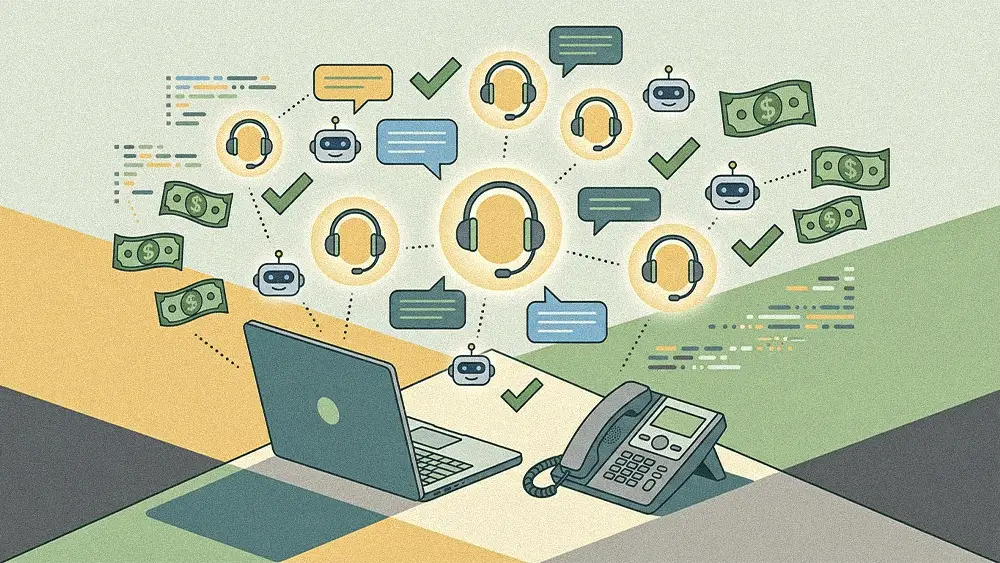
In most deployments the three operate as layers of one system, with conversational AI interpreting and routing requests, generative AI writing responses, summaries and guidance, and agentic capabilities completing tasks across systems. One AI agent handling a billing dispute may draw on all three within a single conversation.
Customer-facing AI agents handle conversations directly, and other agentic tools support human agents during live calls. Cresta's Knowledge Agent, for example, listens to the conversation, reads customer details from the CRM screen and surfaces the policy that applies without the agent typing a search. On the analytics side, Cresta describes the latest version of its AI Analyst as a research agent that plans and carries out its own analysis of customer conversations and recommends next steps.
For deciding which approach a task needs, Gartner analyst Anushree Verma recommends AI agents where decisions are required, automation for routine workflows and assistants for simple retrieval. Many everyday contact center requests fall into the last two groups and can be handled well without an agent.
How to tell whether a product is agentic
The label is applied loosely enough that evaluations should focus on what a system does in practice.
Check whether it takes actions in your systems. An agentic product should be able to update records, issue credits or change bookings through integrations, within limits your team sets.
Find out who decides the next step. If every path was drawn in a flow builder ahead of time, the product is a workflow. That may suit a given use case, but it isn't an agent in the sense analysts use the term.
Ask to see it handle customers who go off script, including topic changes, corrections and missing information partway through a conversation.
Review how its actions are controlled. Look for clear permissions, approval thresholds for sensitive actions such as refunds and a deterministic fallback for situations where improvising isn't acceptable.
Ask how it is tested before launch and monitored afterward. Cresta's engineering team has written about combining simulated customers, LLM-based graders and deterministic checks, and about rerunning regression tests after every model update, a practice that in one case caught an agent that had stopped reading a required compliance disclaimer.
Confirm that it records its work. Every decision and tool call should be logged so a supervisor can see what the agent did and why.
What changes for CX leaders
Agentic AI takes decisions that used to belong to people and hands them to software. Refunds, exceptions and account changes have always been governed by operations, finance and compliance teams, and once an AI agent can make those calls, those teams need a role in configuring and monitoring it.
An agent that completes tasks also needs to be measured differently, on whether customers' issues were actually resolved and whether its actions were correct. Containment rates reveal little about either.
Gartner predicts that agentic AI will resolve 80% of common customer service issues without human intervention by 2029, but reaching that point depends on dependable integrations, current knowledge and clearly written policies. Gareiss has said that many AI projects fail because companies try to do too much at once. That argues for starting with a narrow use case and expanding as results come in.
Frequently asked questions
What is agentic AI in a contact center?
Agentic AI refers to systems that pursue a goal, such as resolving a customer's issue, by deciding which steps to take and using business systems to carry them out with limited human guidance. In a contact center, that might mean checking an order, issuing a credit and updating the CRM within one conversation.
What is the difference between conversational AI and generative AI?
Conversational AI interprets what a customer wants and follows predefined flows to respond. Generative AI writes new language, such as replies, summaries and suggestions, instead of selecting from scripted responses.
What is the difference between generative AI and agentic AI?
Generative AI produces content in response to a prompt. Agentic AI uses generative models to plan and carry out actions toward a goal, including calling tools and business systems, and adjusts based on the results.
Is every AI agent agentic?
No. Many products marketed as AI agents follow fixed, predesigned flows. Gartner calls the practice of relabeling chatbots and assistants as agentic "agent washing."
Does every contact center use case need agentic AI?
No. Simple information requests and routine workflows are often better served by assistants and conventional automation, which cost less and behave more predictably.