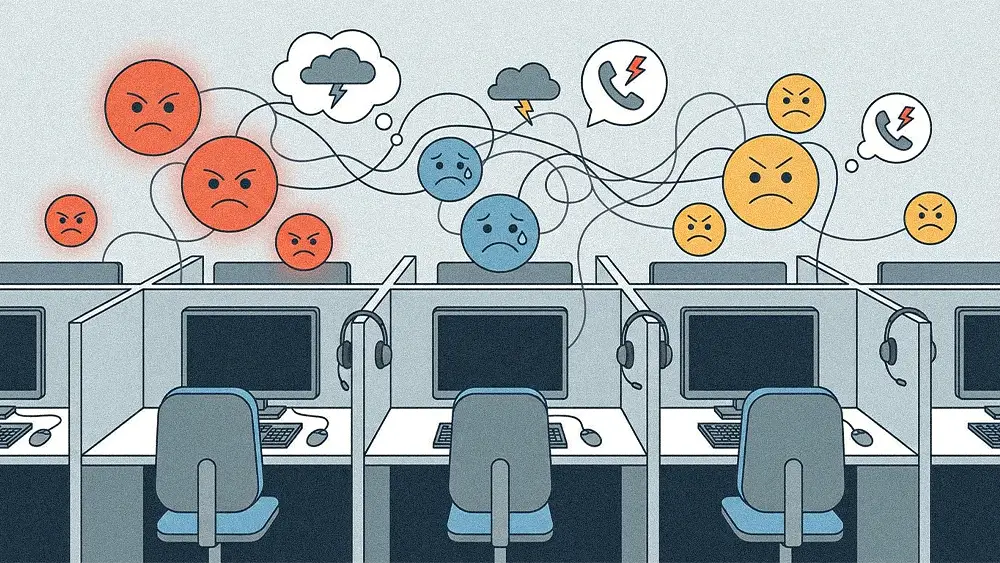

As AI Pushes CX Teams To Compress Timelines, Leaders Learn the Art of Diagnosing Friction
Nicholas Babb, CX Director at McKesson, shares practical strategies for building a winning strategy in a world where CX timelines have shrunk from months to days.

Make CX Current News one of your go-to sources on Google


We use every tool to understand customer buying patterns, then pipe that data into AI to diagnose why they're not progressing in the sales funnel. The more we feed the monkey, the more we get back as an improved user experience.

Nicholas Babb
Customer experience timelines are shrinking. Feedback loops for discovery and testing that once took months or years are now closing in days, setting a new pace for how quickly organizations can adapt to user behavior. The acceleration is forcing a rethink of old workflows, pushing leaders to replace AI theater with disciplined systems that absorb constant feedback and turn it into action.
For strategies to keep pace, we spoke with Nicholas Babb, the CX Director at healthcare services leader McKesson. As a CX and AI leader in a company that supplies a third of North America's pharmaceutical products, Babb is on the front lines of implementing these tactics on a massive scale. That vantage point gives him a clear view of how dramatically iteration cycles have compressed.
"Our iteration times are now measured in days, and that's the new level set," he says. The shrinking timeline fundamentally changes how close CX teams are able to get to the user and how quickly experiences can be improved. "Rage clicks, cart abandonment, dwell times, scroll depth—we get instant feedback on everything. We use every tool to understand customer buying patterns, then feed that data into AI to diagnose why they're not progressing in the sales funnel. The more we feed the monkey, the more we get back as an improved user experience."
The AI reset: Operating at this new velocity often demands a tactical reset after the initial push to adopt AI. Many leaders, Babb says, mistake AI for a magic solution that can paper over existing failures in old workflows. "A lot of businesses expect AI to be the silver bullet for their problems instead of treating it like a tool in the toolbox."
Strategizing for speed: For his team, the first step was carefully analyzing where the technology could best be of use. "We took about three months to understand where that layer gets involved in our process and to plan with our developers how to keep them from bottlenecking as we move at this pace."
To embrace rapid iteration, Babb advocates for a 'fail fast' mindset, using small pilots to build internal confidence and gather feedback before expanding. "Take something small and build that small thing first for your proof of concept. Then take all those learnings and pipe them back in so you're feeding the model over and over." This method, he explains, allows teams to get to know the technology inside and out and gain confidence at a realistic pace.
Human hurdles: Proper pacing is important to overcome one of the biggest obstacles in AI adoption: the psychological one. "We're human. People like to go back to what they know, the safe space," Babb notes. He explains that this resistance is often a key driver of the friction that complicates AI initiatives and creates internal frustration.
The CXO slowdown: On the other side of the coin, teams can also get too ambitious chasing unvetted tools, forcing a rewrite of the CXO's job description. "I became the bottleneck the moment we went to AI," Babb says. "My team has constant questions about which new technologies we should or shouldn't implement. A huge part of my day is now spent managing those conversations before turning around to set executive expectations on deliverables and benefits."
To counter these competing frictions, Babb advocates for a disciplined but flexible framework that gives employees leeway within guardrails. "I love giving developers and designers space, but they have to be managed." He describes a recent scenario where a designer mentioned using an emerging AI plugin, which was news to him. "I said, 'wait a minute, it's not even vetted.' It's really important to pull that back and have the team focus on what's fundamental for the MVP."
A moving target: Babb stresses that even with a closely defined focus, the bottleneck in an AI-driven workflow often can't be eliminated. It just relocates. "Now we have data scientists chasing outputs, which means the design team is waiting on them for strategic direction. So we're building a tool to un-bottleneck them. We're literally building tools to build tools, and at the end of that chain, there's always a new bottleneck waiting."
AI appraisal: To maintain a strong customer experience amid the innovation, his organization uses a detailed roadmap tied to business objectives. "We have a clearly defined map showing inflection point where we're going to layer AI into a specific vertical or process, along with the priorities." He says such an approach is vital not just for direction, but for pragmatically deciding what really requires AI. "Do you need it in everything? No, you probably don't."
As experts strive to predict how AI will continue to reshape customer experience, Babb's message for leaders is one of urgency. "Embrace AI now at whatever cost, even if it's a hard sell to the C-suite. Make them understand this is the new way forward. It is not going to change." Looking ahead, he believes an organization's viability depends on being able to access accurate data within a real-time feedback loop. "If you don't act now, the landscape will change so fast you'll be left too far behind to ever come back."