
Why Churned Customer Data is the Missing Input for Predictive Health Scores
Vinova Deniz, Head of Customer Success at Wiza, explains how replaying churned customer lifecycles and feeding that data into predictive analytics is redefining how CS teams build health scores, detect risk, and allocate resources.
Make CX Current News one of your go-to sources on Google


Churned customers are a huge treasure trove of data points. When you look at their entire lifecycle, from onboarding to where healthy adoption dropped off, it paints a holistic picture of where things actually went wrong.

Vinova Deniz
Customer success teams keep refining health scores, yet churn still surprises them. The missing insight often sits inside the accounts that already walked away. Instead of guessing which metrics signal risk, the smarter move is to mine churned customer lifecycles for the patterns that expose where adoption stalled and value broke down.
Vinova Deniz is the Head of Customer Success at Wiza, a B2B data intelligence platform that provides real-time verified contact information for sales prospecting. Before joining Wiza, she spent four years as a founding member of the customer success team at Canva. She also serves as a Chapter Lead at Women of Customer Success and an angel investor at Her Workplace. Today, she applies that lens to one of customer success’s most stubborn blind spots: preventable churn.
"Churned customers are a huge treasure trove of data points. When you look at their entire lifecycle, from onboarding to where healthy adoption dropped off, it paints a holistic picture of where things actually went wrong," says Deniz. She sees a broad shift in what CS leaders are measured on across customer experience organizations. Instead of treating net revenue retention as the core KPI, teams are drilling into the specific behaviors that feed it: segmentation, time to value, and adoption metrics that reveal whether customers are getting what they need.
The churned customer lifecycle, she argues, is where the most useful signals live. Most teams let that data disappear once an account closes. Deniz treats it as the baseline for rebuilding her health score models.
Let the data lead: Rather than building a health model around what a CS leader believes signals risk, Deniz advocates feeding churned account data into predictive tools and letting the patterns emerge on their own. "Instead of me saying that 50% utilization is a red flag and then validating my own assumptions, plug all of that churned data back and look for trend patterns. Let predictive analytics tell you what your health scores should look like rather than building from what you already believe."
Track the right users: At Wiza, one of the most revealing findings from churn analysis was that overall account usage was less predictive than the behavior of specific user types. "When we looked at our churn data, it actually showed that when admins stop using the platform for a certain number of days, that becomes a stronger predictor than general account usage. You have to constantly go back and reevaluate: is this true for this segment? How does this change our health score moving forward?"
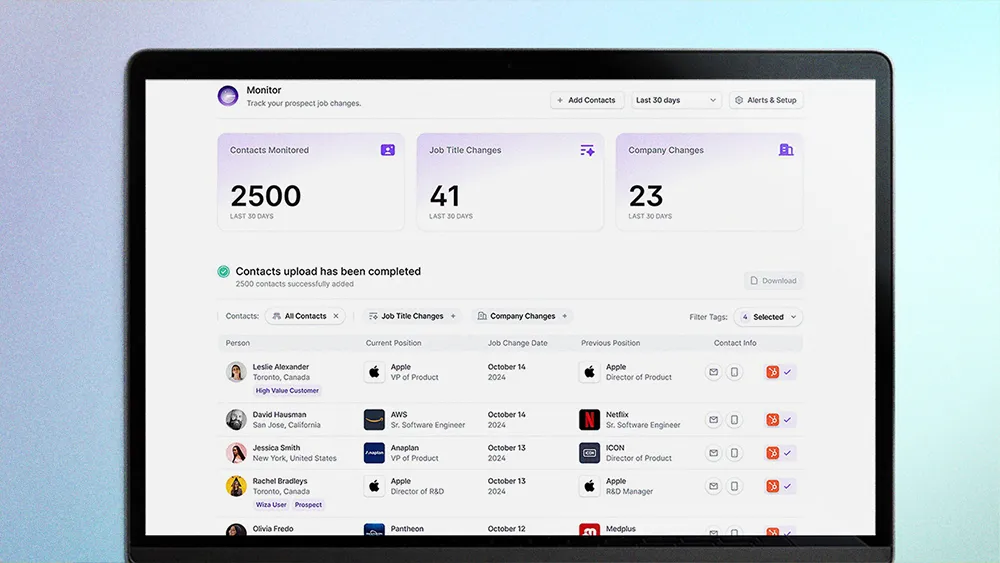
This data-first thinking extends into how Deniz builds playbooks around champion departure, one of the most discussed but least detectable risks in customer success. Email bounce rates are unreliable because inboxes get inherited. Usage drop-off is a lagging indicator. Deniz instead tracks disengagement patterns and uses tools like Wiza and LinkedIn to detect when a champion has changed roles before the signal shows up in product data.
Continuous improvement: "Your entire relationship ends up living in one person's inbox and you end up in a hostage situation," she says. "The more you can track the momentum of your champions, your executive buyers, and your power users proactively, the better positioned you are to act before the typical indicators even appear." On health scores more broadly, Deniz warns against treating them as set-and-forget systems. Her team at Wiza is on its fourth or fifth version in roughly six months.
Yellow is where preventable churn lives: Most CS teams funnel their attention toward accounts already flagged as critical, but Deniz says the real opportunity sits one tier above. "We get really obsessed with red accounts and we ignore yellow accounts, where things that aren't yet on fire are going to turn into fire. That's where most of your preventable churn actually lives."
Health scores decay: A health model built six months ago may no longer reflect how customers actually use the product today, especially after new feature releases or pricing changes. "As you add features to your product, your health score should evolve too. Are customers using new products? Do you track that? A lot of health scores today look like mood rings. They tell you something you already know, but you're not staying as dynamic as your product or your customers."
Deniz also makes the case that onboarding needs its own distinct health scoring framework, one built on real behavioral benchmarks rather than arbitrary timelines. Holding new customers to the same health criteria as mature accounts creates a misleading picture. "Customers should enter maturity after a certain level of usage and value uncovered, not after 90 days," she says. "That shouldn't be time-bound at all. Every account should have at least two health scores: one during onboarding and one after they've matured."
For CS leaders looking to close the gap between what their dashboards show and what is actually happening inside accounts, Deniz's advice is direct: stop building health models based on what you think healthy looks like. Start with the customers who proved you wrong.