

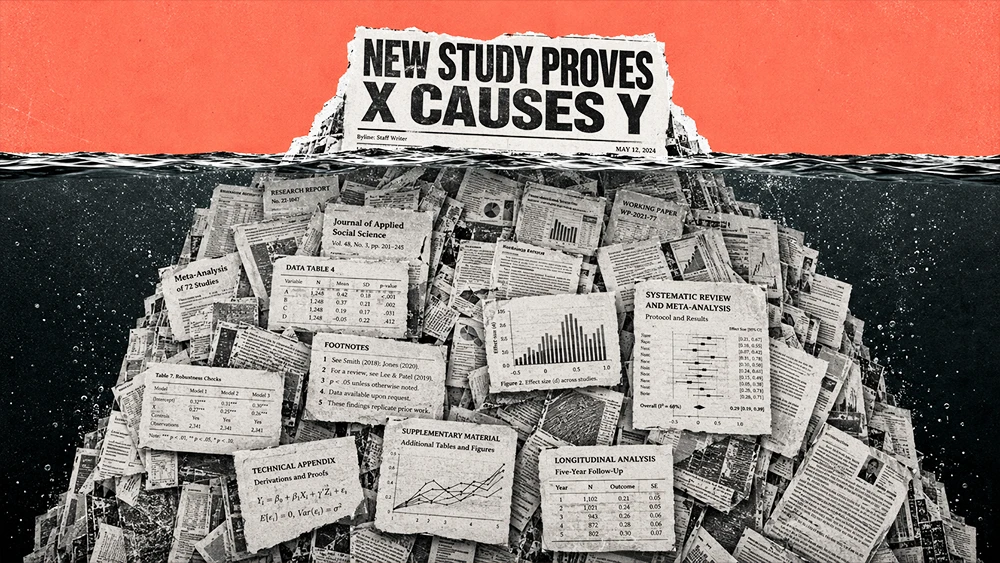
The headline has impact on its own, but when leaders repeat it, that impact gets amplified across the organization. It shapes what people do two months out, three months out, six months out.
 Sudi NavileChief Customer Officer and Principal Business Value Advisor @ SID Global Solutions
The MIT stat claiming 95% of AI projects fail has been cited in board meetings, keynotes, and strategy decks across every industry. It showed up at Dreamforce. It circulates in executive conversations that shape budgets and roadmaps months out. Almost nobody who repeats it has read the report. The stat is real, but what it actually says, and the nuance buried inside the research, rarely survives the headline.
Sudi Navile is Chief Customer Officer and Principal Business Value Advisor for Digital and AI at SID Global Solutions, a digital transformation consultancy, and author of the Medium series, Threads and Perspectives, a weekly exploration of what’s new and how it connects. Over 30 years, he has held CIO and COO roles across enterprise software, consumer products, and global consulting, and currently focuses on AI operating models, agentic enterprise design, and responsible AI governance. He reads the reports that get cited in executive conversations and has started asking people directly whether they have done the same. Most have not.
"Because people at this level are talking about it without taking the time to really understand it, the rest of the world starts treating it as more than a headline," Navile says. "The headline has impact on its own, but when leaders repeat it, that impact gets amplified across the organization. It shapes what people do two months out, three months out, six months out."
Headlines create organizational momentum
The problem runs deeper than misinformation. A headline like "95% of AI projects fail" enters the executive conversation and generates decisions: kill the pilot, pause the investment, shift the roadmap. Navile took the time to read the full report and presented six data points from it at a keynote. The audience was surprised. "Then I said, by the way, this is the same report. The 95% fail report," he says. "People were not ready to believe it."
The cultural roots predate AI. The binary thinking of social media, the endless scroll that replaces depth with volume, and the loss of gray in how people process information have all conditioned teams to accept headlines as conclusions. "We don't have time to research a headline, but we have three hours to scroll endlessly and read hundreds of headlines," Navile says. "I don't understand that."
Customers can tell
The trust consequence shows up directly in customer relationships. When teams use borrowed claims and AI-generated summaries to sound informed, the gap between perceived expertise and actual understanding becomes visible fast.
"In the consulting industry, you have ten seconds more than the customer," Navile says. "The customer can research while you're talking and hit you back." Teams that build their engagement on headlines rather than genuine understanding lose credibility in real time.
The deeper service failure is not reading the room. Navile uses a recurring example: a customer asks for a space shuttle when they need a car to drive 10 miles. "The customer wants you to get them from point A to point B," he says. "Not build a space shuttle."
He applies the same principle to support: when someone calls about a broken-down car, the first question should be where were you headed today, not what is wrong with the engine. That instinct, solving the customer's actual problem rather than the stated technical one, requires the kind of listening and preparation that headline culture erodes.
Preparation is the fix
Navile's prescription is operational. A 30-minute customer meeting needs a one-hour mock, and the mock needs half a day of preparation behind it. "For the thirty-minute conversation to be effective, you can't fake it," he says. Over time, the preparation time compresses as teams build the muscle. But the muscle has to be built first. "It's okay to take the bait," Navile says of headlines. "But what are you going to do after you take the bait? Do the research."
Scaling the discipline follows a familiar pattern: get one success, turn it into two, let ambassadors carry it to four, and build toward organizational critical mass. AI can add velocity to that process, but only after the foundation of understanding exists. "Scrolling is a habit," Navile says. "You did not have that habit before. Preparation can be a habit too."
The organizations that treat customer engagement as a discipline rather than a performance are the ones whose teams and customers notice the difference. "AI is going to amplify the behavioral problems we already have," Navile says. "Your speed will come as you build your muscle. You can't scroll your way to success."