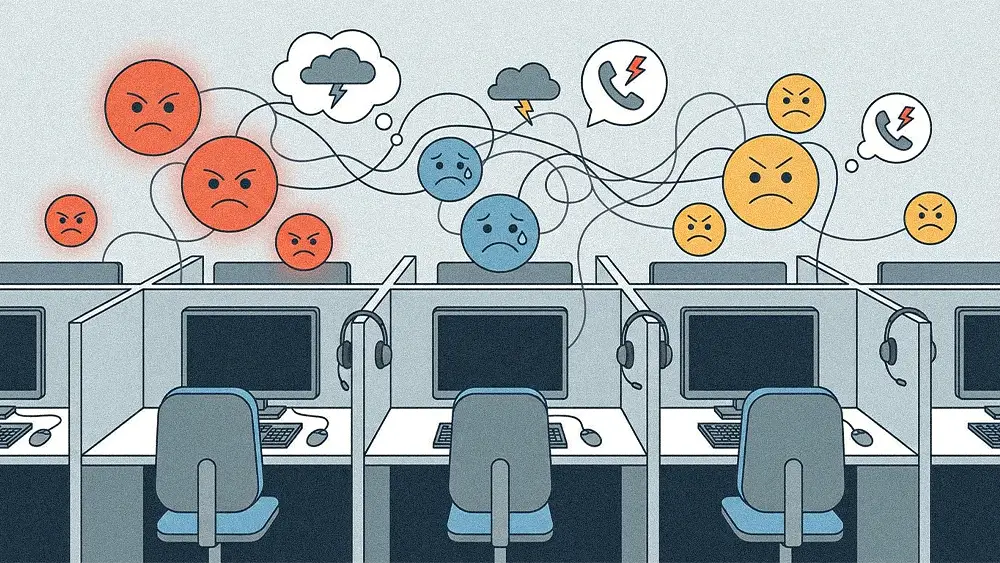

Fixing Contact Center Data Gaps Starts With Narrowing AI's Focus
Blackadder Consulting Founder and CEO Craig Howarth explains why CCaaS success is a sequencing problem, urging leaders to fix their data foundations and call flow strategy before chasing the latest AI feature sets.

Make CX Current News one of your go-to sources on Google


Pick the few things you want to do well with AI, and make sure you can actually stand them up.

Craig Howarth
Contact center artificial intelligence is facing a reality check. In some enterprise structures, executives disconnected from the call center floor are signing checks for shiny new features based on promises of massive headcount reductions, but they often ignore the unglamorous reality of their own data. At the highest level, success is not about picking the right feature off a spreadsheet. Instead, the real differentiator is the heavy lifting required to build a unified orchestration layer that connects disparate legacy systems before a single AI capability is activated.
According to Craig Howarth, Founder and CEO of Blackadder Consulting and a technology leader with deep experience, the organizations that actually see results are the ones that do the hard work before signing a contract. His central argument is that leaders need to build a clear, realistic wish list before entering any evaluation.
"Pick the few things you want to do well with AI, and make sure you can actually stand them up." This, he says, means understanding not just what capabilities a platform offers, but what internal infrastructure, data readiness, and process maturity are required to make those capabilities work.
A missing foundation: As an example, Howarth points to agent assist, a feature that quickly surfaces relevant knowledge and reduces the time an agent spends searching for answers. He says the concept is compelling, but making it function well depends entirely on the data it connects to. "If you don’t have the data and integrations ready, you’re not really in a position to take advantage of what’s being sold." If an organization's knowledge base is scattered across SharePoint sites, client-specific portals, and legacy systems, and if that content isn't structured in a way AI can parse, the tool won't deliver on its promise without significant groundwork.
The price of entry: That groundwork represents a cost many leaders underestimate. There's the direct financial investment in integration and data preparation, and then there's the operational cost, including the time, people, and process changes required to ensure these capabilities can function. "You might have to go and rewrite your knowledge base just to get into the game," Howarth explains. When those costs aren't accounted for upfront, organizations end up with powerful tools that sit underutilized.
Another common challenge Howarth identifies is with harmonization. Stacking six or seven AI features onto a single call flow doesn't always multiply value. Instead, it can create confusion. When tools compete for the same sliver of efficiency, agents can end up overwhelmed rather than empowered. "All you're left with is an AI mess." He advocates for a more productive approach of defining where in the call flow AI adds the most value and committing to executing well in those areas. Two or three well-implemented capabilities, he says, will outperform a dozen half-deployed ones.
For real ROI, start simple: For leaders seeking an immediate, realistic return on investment, Howarth advises starting with the practical utility of after-call documentation. "This is a low-hanging fruit. If you're in an environment where you have to document what happened on the call for regulatory reasons, all you need is the capability for speech-to-text and an integration with the CRM." This functionality removes repetitive documentation work for agents while largely bypassing the need to rework a company's entire knowledge base.
Include the operators: Too often, Howarth sees technology purchases and strategies driven by leaders who are adjacent to the contact center, but haven't worked inside one. He believes more weight should be given to the input of operators who manage day-to-day contact center performance, as they know how agents actually work and where the real friction points lie. "At the end of the day, they're the ones who are going to be held accountable to the benefits that are promised, but they're not in the conversation enough." He says including this group earlier in the process is how organizations avoid buying capabilities they can't realistically deploy.
The throughline in Howarth's perspective is that successful CCaaS and AI adoption is a sequencing problem, not a selection problem. The platforms are capable. The AI features are real. The advantage goes to organizations that narrow their focus, invest in what they can execute today, and build toward more advanced capabilities as their data, integrations, and operational maturity catch up. "Know what you want, keep that list tight, and build from there," he concludes.