

If you're not advancing with technology and tools, your competitors are and you're going to be left behind. Even companies with cultures and regulations that make implementation difficult are eager to adopt AI technology. They know that if they don't, they will go under because someone else will.
 Rachel BlochConversational AI Designer @ Cresta
Until recently, the performance gap between top-performing agents and the rest was widely accepted as a cost of doing business. Lacking visibility into the origins of this gap, most leaders relied on broad directives and random call interviews. But now, that era is over. Because today, AI provides the tools to close that gap.
Rachel Bloch, a Conversational AI Designer at Cresta, has built her career on using technology to bring out the best in employees. With experience as a Dialogue Designer for Google’s CCAI division, and as the author of a section in "The Global Impacts and Roles of Immersive Media," Bloch's philosophy is that technology can elevate agents rather than replace them. Today, her approach is built on the new level of operational visibility made possible by AI.
"A manager may have reviewed one call a month from one of their agents, picking a call that's not too short and not too long to review together. But reviewing one call is nothing compared to their total call volume," Bloch says. Now, AI is moving teams from having almost no insight into a complete, data-driven picture—almost overnight.
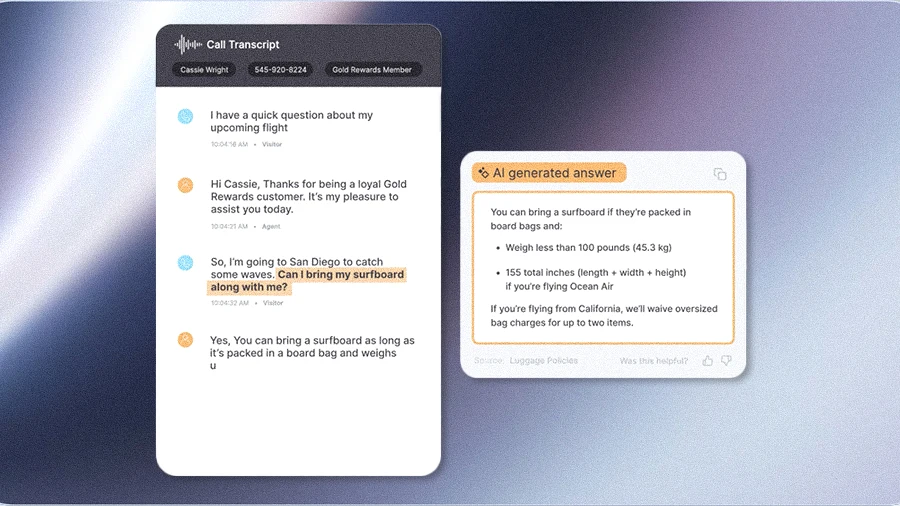
The view from above: In the past, agent coaching was more art than science, relying on anecdotal evidence and guesswork, she explains. "Now, managers and even execs have full visibility. They can tap in and listen live to any call, see breakdowns of topics and trends, and know who's performing a behavior and who's not. They can even generate a performance leaderboard instantly." Over time, that visibility becomes the proactive engine for closing the performance gap and developing excellence.
By pairing human expertise with AI-driven analysis, conversation designers can systematically identify the successful patterns of top agents and translate them into coachable behaviors. Using AI for rapid hypothesis testing, the process allows leaders to validate a strategy with data before committing to a full-scale rollout, minimizing risk and maximizing ROI.
Man meets machine: The goal is to find what works, Bloch says. Then, build an AI-powered system to coach every agent on those winning behaviors. "Our idea is that we can turn all of your agents into top agents. It's a mixture of both human expertise and AI. You might be using AI tools to validate insights from their scorecard or our domain knowledge, rather than always using it to discover something entirely new."
Prompt and prove: Identifying winning behaviors is one thing, Bloch continues. But ensuring they are executed consistently is another. By creating a closed feedback loop in real time, AI can be engineered to solve this challenge, she says. "The process involves training generative AI models to do two things. First, to recognize the right moment in a call to coach an agent on a specific behavior, and second, to recognize when the agent actually performs that behavior."
Such visibility also provides its own guardrails, Bloch explains. By flagging missing mandatory statements, the technology shifts compliance from a reactive, after-the-fact problem to a proactive process, potentially saving companies from costly fines. "Companies in highly regulated industries are even more intrigued by what this technology can do. The visibility it provides is incredible, allowing them to see in an instant that a critical statement is only being said 50% of the time when it needs to be on every single call." However, that level of thoughtful implementation often requires a human touch, Bloch explains.
For Bloch, building fair and effective AI also means carefully considering the data used for training. "When training AI models, you have to consider the source data carefully. For example, if you train a model on agents from one region, it may not work well for agents in another. You also have to account for high agent turnover and ask if the model will be obsolete in three months because you have completely new agents."
The pressure to adopt this technology is no longer a suggestion, Bloch concludes. Now, the new standard is raising the bar for what's considered "average" to align with the very best. And as companies race to innovate, the fear of being outpaced is beginning to outweigh long-held resistance to change. "If you're not advancing with technology and tools, your competitors are and you’re going to be left behind. Even companies with cultures and regulations that make implementation difficult are eager to adopt this technology. They know that if they don't, they will go under because someone else will."